


Half the room is a number you can move.
You sent the confirmations, printed the badges, and watched half the room stay empty. The drop-off isn’t random, and it’s fixable.
Anyone who’s run events knows the quiet math of it: register a thousand, brace for a room closer to five hundred. That instinct is right. Across 33,000-plus sessions in Livestorm’s 2026 benchmark, the average show-up rate for webinars and virtual events sat at 47.7%. In-person and paid formats do better, but the gap between “registered” and “in the room” is real at every event. Bracing for a chunk of the room to stay home isn’t pessimism; it’s the baseline you’re working against.
Here’s the part worth holding onto. People don’t skip an event they signed up for at random. They drop off for specific, predictable reasons: weak reminders, no real commitment, friction at the door, content that stopped feeling relevant, and each one has a fix you control.
The goal here is simple: close the gap between the number who sign up and the number who walk in, rather than just registering more people to absorb the losses. Below are the reasons registrants don’t show, the fix for each, and what moves the number most.
Why Registrants Don’t Show, and the Fix for Each
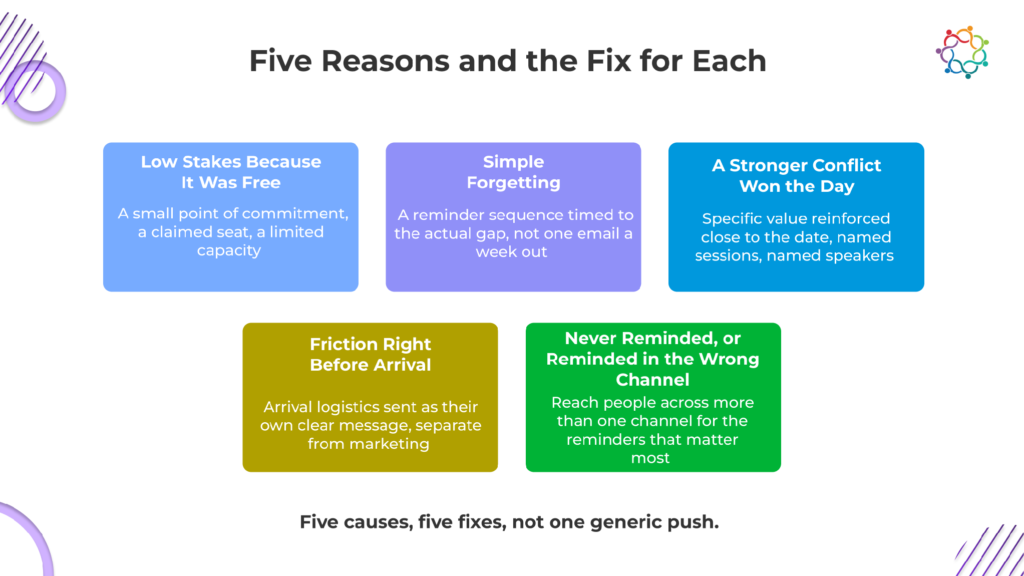
People skip events they registered for in patterns, not at random. Here are the six that account for most of the drop-off, each with the fix.
- It slipped their mind. They registered three weeks out and had forgotten by the day. The fix is a reminder sequence spaced across the run-up, with the last one landing the morning of. A short reminder sequence across email and WhatsApp does more for turnout than almost anything else on this list, because forgetting is the most common reason and the easiest to solve. Three touches beats one long email nobody opens: a save-the-date, a day-before nudge, and a morning-of note that says you’re starting soon.
- It never made it onto their calendar. Holding a calendar spot and registering are two different things, and most individuals only do the former. The solution is a one-click calendar add-in for the confirmation and each reminder, together with RSVP management software that identifies confirmed attendees so the event has an actual time slot rather than existing in an email. Most people never add the event at all if the calendar button isn’t in the confirmation, which is the highest-intent moment you get with a registrant.
- Nothing was committed. A free registration costs nothing to skip, so it gets dropped first the moment the day fills up. The fix is to raise the small commitment: a required question, a session to pick, a seat to confirm. When a person puts something in before the day, they show up to collect on it. Even a tiny ask, choosing a breakout or answering one question, flips someone from a passive sign-up to a person with a plan for the day.
- The day-of friction was too high. A long check-in line or a vague location turns a soft maybe into a no before the person even arrives. The fix is to make arrival effortless: clear directions the day before, mobile check-in, and a QR code that works on the first scan rather than a clipboard and a queue. Attendees decide whether the event is worth the hassle in the first ninety seconds at the door, and a line is the fastest way to lose the borderline ones.
- It stopped feeling relevant. Between sign-up and the event, priorities shift and the agenda fades from memory. The fix is to keep it warm in the weeks between: a speaker highlight, a session matched to their interest, a reason to still care, so the event stays a live commitment rather than a fading one. A single note in the final week, along the lines of “here’s the session we added for people in your role,” pulls back a real share of the drift.
- The wrong people registered. Some sign-ups were never a fit and were always going to skip, which is a targeting problem wearing a turnout costume. The fix is to aim registration at the audience the event is for, so the list comes in smaller but far more likely to show up. A smaller list of the right people beats a big list of the wrong ones every time, because show rate follows fit.
Common trap: treating a bigger registration number as the fix. Doubling sign-ups to cover a 50% no-show rate just doubles the cost of the empty seats and the effort chasing them. Moving the show rate up a few points is cheaper, and it compounds at every event after.
Why Generic Reminders Do Not Move the Number
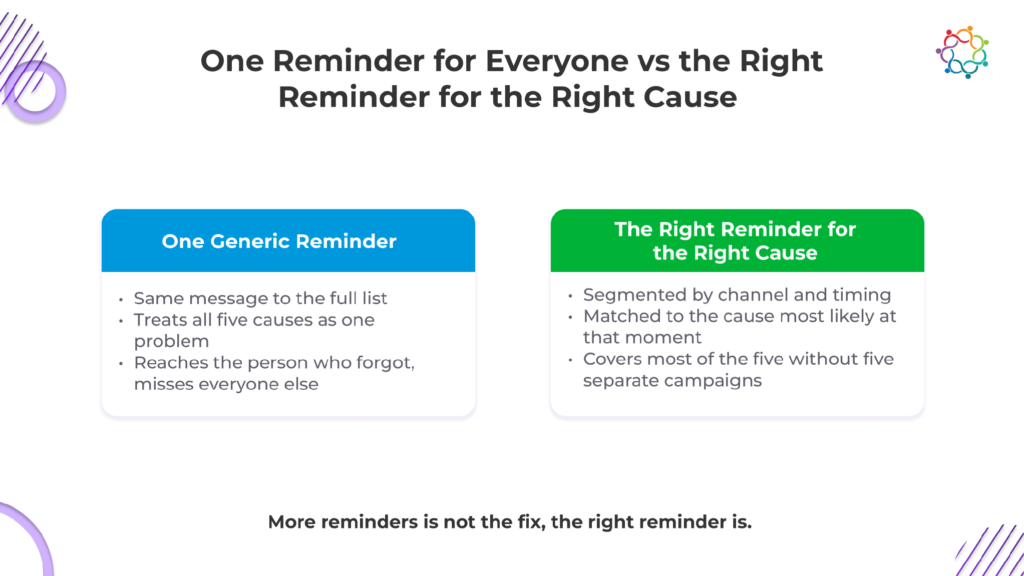
Not every fix carries the same weight, so it helps to know where to start. Two changes do the heavy lifting: a real reminder sequence and an easy calendar hold. Together, they address the single biggest driver, plain forgetting, and they take about a day to set up. If you only touch two things before your next event, touch those. The reason they work is boring but reliable: they hit the biggest cause of no-shows, forgetting, at the exact moments a person decides whether to come.
The next tier is relevance and targeting. Keeping the agenda warm in the weeks between, and aiming registration at the right audience in the first place, both quietly lift the show rate by making sure the people who signed up wanted to be there in the first place. These take more thought, but they change turnout at the root rather than patching it at the end. Targeting is the slowest to fix and the most durable, because a well-matched list keeps paying off at every future event, not just the next one. For the fuller tactical playbook, from confirmation flows to on-the-day nudges, Samaaro’s guide to turning clicks into seats goes deeper than there’s room for here.
What doesn’t move the number, despite being the reflex, is spending more to drive more registrations. A bigger top of funnel with the same leaky middle just means more people who registered and still didn’t come. Show rate is the number worth optimizing, and it’s the one most teams keep ignoring.
Find Your Own Biggest Drop-Off
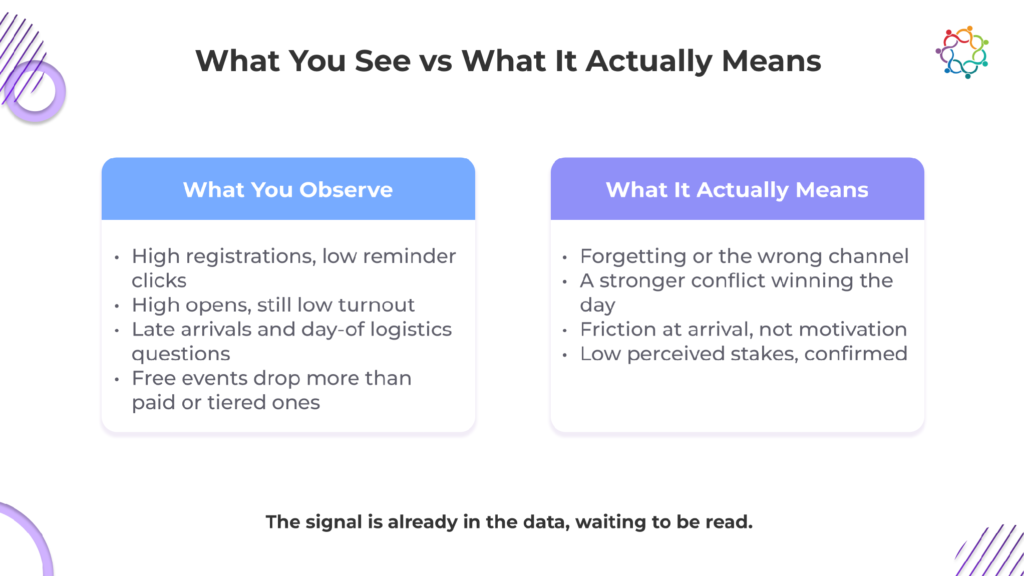
The six reasons aren’t equally true for every event. Before you fix everything at once, find the one costing you the most seats.
- Segment your no-shows. Look at who registered but didn’t attend, broken out by role, seniority, or account, the way a good post-event debrief does it. If a specific group signed up heavily and showed up rarely, that pattern points straight at the reason. The gap is almost always concentrated rather than evenly spread, so naming the group that vanished tells you more than the overall rate does.
- Check where the drop happened. A cliff between registration and the calendar hold points to reason two. A cliff on the day itself points to friction at the door. The shape of the drop tells you which fix to reach for first.
- Fix one thing, then measure. Change a single variable for the next event, a reminder cadence, a calendar add, a tighter invite list, and compare the show rate. Turnout responds to specific changes, so you can prove which one worked instead of guessing. Change three things at once and you learn nothing; change one and you learn exactly what moved the number.
Move the Number You Can Move
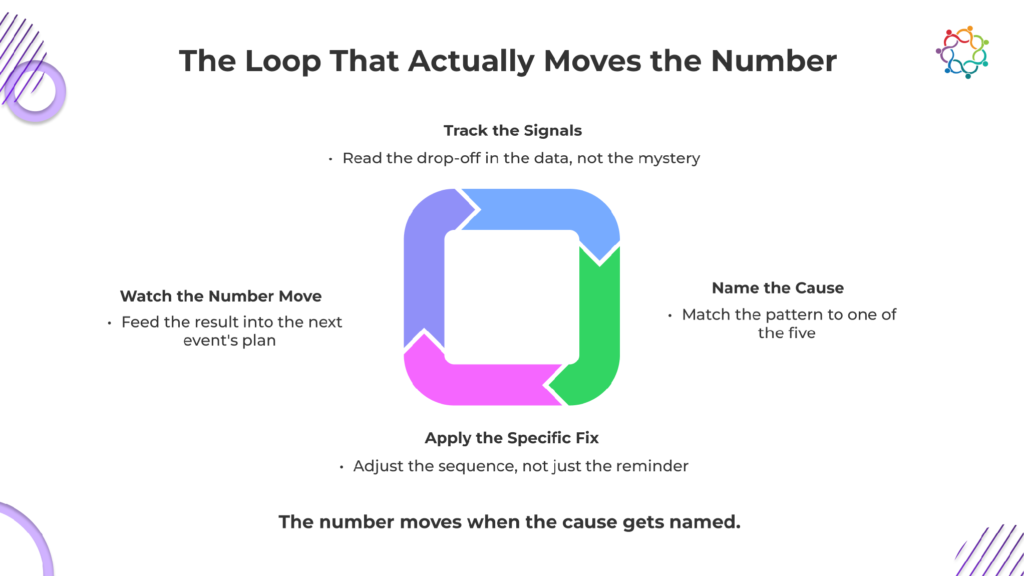
You will never get everyone who registers to show up, and that’s fine. The point isn’t a perfect room. It’s recovering the seats you’re losing to reasons you can predict and fix: the reminder that never came, the calendar slot that was never held, the friction at the door, the relevance that faded. Those seats are already yours on paper; the work is making sure they’re yours in the room.
So the next time the confirmations go out, don’t just hope the room fills. Pick the two reasons that sound most like your events, fix those first, and the show rate moves faster than a bigger guest list ever could.
For a read on where your own drop-off is happening and which fix would move it most, talk it through with the Samaaro team.