

When the closing keynote ends and the last booth is packed up, most people think the event is in the rearview mirror. The energy shifts; the team celebrates; the metrics, registration figures, attendance numbers, social chatter, start getting circulated on internal channels. For many organizations, this is where the story ends.
For enterprises, however, the heavy lifting is just beginning.
Events may represent one of the largest line items in an enterprise marketing budget. Between venue, sponsorships, technology, accommodation, and travel, one flagship event can represent crores in investment. Still, event teams too often cannot articulate how those investments translate into measurable business impact.
This is why post event evaluation is not just a box to tick, it’s a necessity. It helps turn an event from a one-time experience into a repeatable, scalable, and strategic growth engine. When done well, an evaluation will provide an enterprise with the perspective to refine targeting, improve execution, and demonstrate ROI back to leadership.
In this blog, we’re going to explain what post-event evaluation entails, why it matters so much for enterprise events, and how to develop evaluation processes that turn a flurry of activity into actionable strategy.
Events Don’t End at the Closing Session
It is tempting to evaluate success based on how busy the venue felt or how many tweets were sent out. For teams that have invested long hours, these energizing moments can feel like validation.
But while these surface-level markers might deliver a short moment of joy, they will never provide insight into whether an event met its business objectives. For instance:
- A financial services enterprise may celebrate achieving attendees at its annual summit. While the numbers may look good on a page, upon further inspection by sales teams, they will likely see only a small portion of those attendees had decision-making authority and only a handful moved into pipeline conversations.
- A global IT brand may receive rave reviews from attendees about the quality of their sessions, but a closer look may show terrible sponsor engagement and therefore, partners question the value in investing again.
These examples demonstrate a reality: an event can look good but not be strategically good. Post-event evaluations allow enterprises to look at the value not just with the “closing moment” but the longer-term value.
What Exactly Is Post-Event Evaluation?
Post-event evaluation is a systematic and data-driven assessment of the outcomes of an event against its intended objectives. It is much more than just a report of what occurred; it is also, an assessment of an understanding of why it occurred and what next steps will be.
- Reporting only measures “the what”: how many attended, how much was spent, what was rated satisfaction scores.
- Evaluation goes on to measure the “so what”: Were those attendees the right ones? Did the event impact the pipeline? Were these cost justified relative to the outcomes?
This is an important distinction. Reporting is good for ticking boxes. Evaluation develops strategy.
When events are part of enterprise with larger budgets, greater scrutiny of event impacts is critical. There will be no future events if evaluation does not happen. Evaluation is the evidence to provide credibility to event marketing at the boardroom level.
Why It’s Critical for Enterprise Events
Enterprises usually work on a scale where mistakes are costly, and victories must take place time and time again. For three reasons post-event evaluation becomes essential:
1. Enterprise Stakes Are Higher
Unlike smaller organizations, enterprises attach themselves where sponsorship support exists, multi-team collaboration events, also known as C-suite engagement events, tend to be very visible. However, without evaluation there is a risk of reputational damage and wasted time.
2. Proof of ROI is Needed
Businesses are always required to justify their marketing spends. Digital channels like paid advertising and ABM platforms provide instant insights to evaluate ROI. If the evaluation of other forms of marketing provides no actionable, actionable insight, and/or things to improve, they’re likely to be deprioritize by the budget. Evaluation is how events remain competitive to be able to improve.
3. Events are part of a program not an event.
Businesses do not run single events but conduct programs over several quarters and geographic areas. Your learning from one event must inform the next. Evaluation helps to best ensure the knowledge is not reset every time an event is run.
Example:
In a series of roadshows across APAC, a leading B2B SaaS company experienced strong registration rates leading up to their early roadshows, but high no-show rates. When they reviewed their post-event evaluations, they learnt the timing of their events coincided with regional holidays. By adjusting the timing of a few subsequent events, they reduced their no-show rates by 30%, providing a relevant ROI improvement.
The Core Components of Post-Event Evaluation
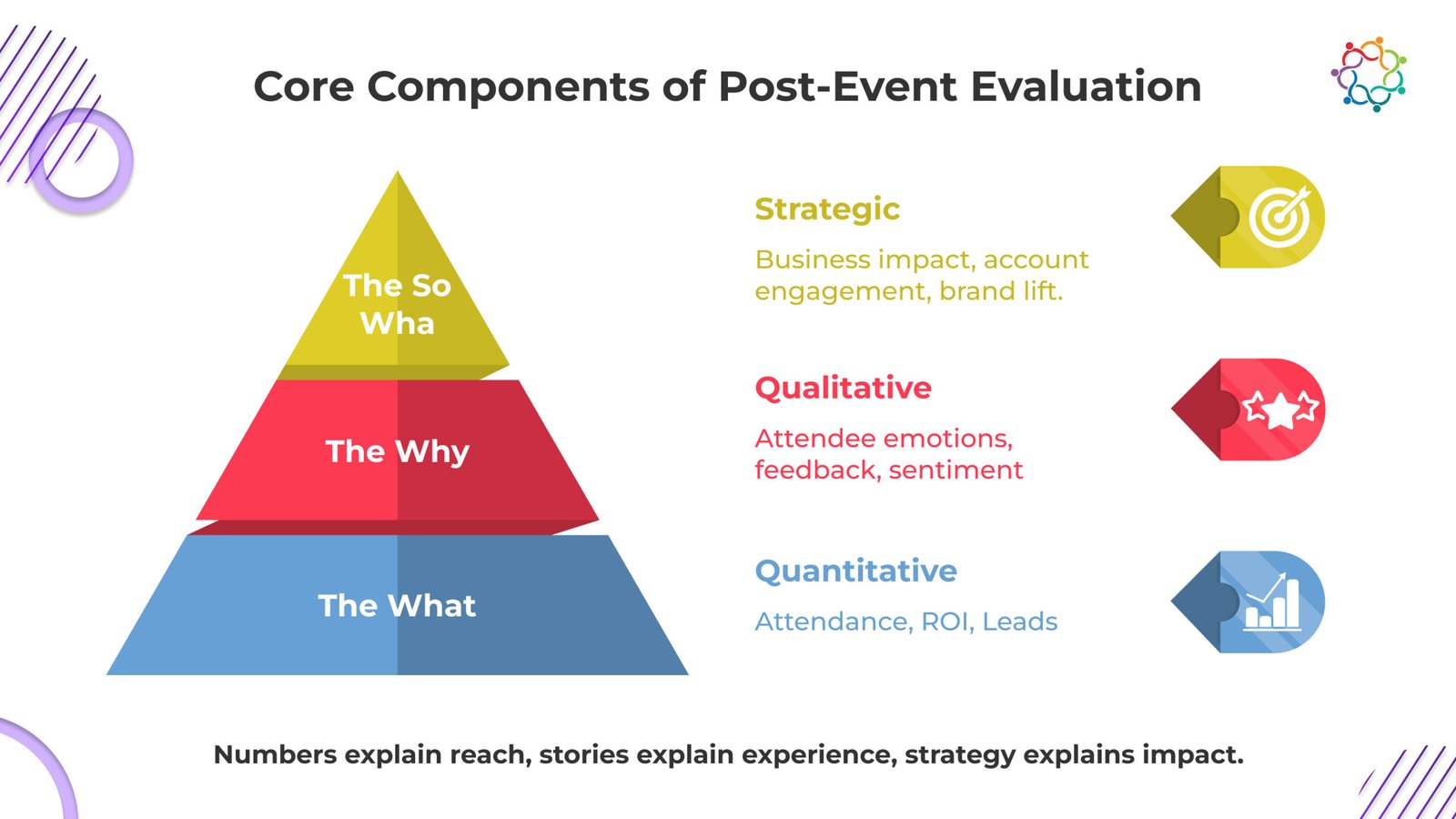
Robust evaluation draws on three types of data: quantitative, qualitative, and strategic. Each adds a layer of clarity enterprises need to form the full picture.
1. Quantitative Data – The Hard Numbers (The What)
Quantitative data measures scale, efficiency, and outcomes in absolute terms.
- What it includes: Registrations vs attendance, no-show rates, NPS/CSAT scores, leads generated, deals influenced, cost vs revenue (ROI %).
- What it does: Quant data provides a baseline for measurement and comparability across events. For example, tracking ROI % allows CMOs to defend event budgets against other marketing channels.
2. Qualitative Data – The Human Experience (The Why)
Qualitative data captures the emotions, perceptions, and stories that explain attendee behavior.
- What it includes: Open-ended survey responses, social media comments, speaker and sponsor reflections, internal team notes.
- What it does: Qualitative data provides context and depth. Numbers might show low engagement in a session, but attendee comments can reveal the session was “too product-heavy” or “not interactive enough.”
3. Strategic Data – The Business Alignment (The So What)
Strategic data connects event outcomes to enterprise goals.
- What it includes: Impact on account-based marketing (ABM) strategies, engagement with new vs existing customers, brand lift among target audiences.
- What it does: Strategic data validates whether the event contributed to business growth. For example, a CXO dinner may only have 50 attendees, but if 10 were high-value accounts that moved further down the pipeline, the event is a clear success.
Together, these three layers prevent enterprises from being misled by vanity metrics. Instead, they build a multi-dimensional narrative of success.
Common Pitfalls Enterprises Face
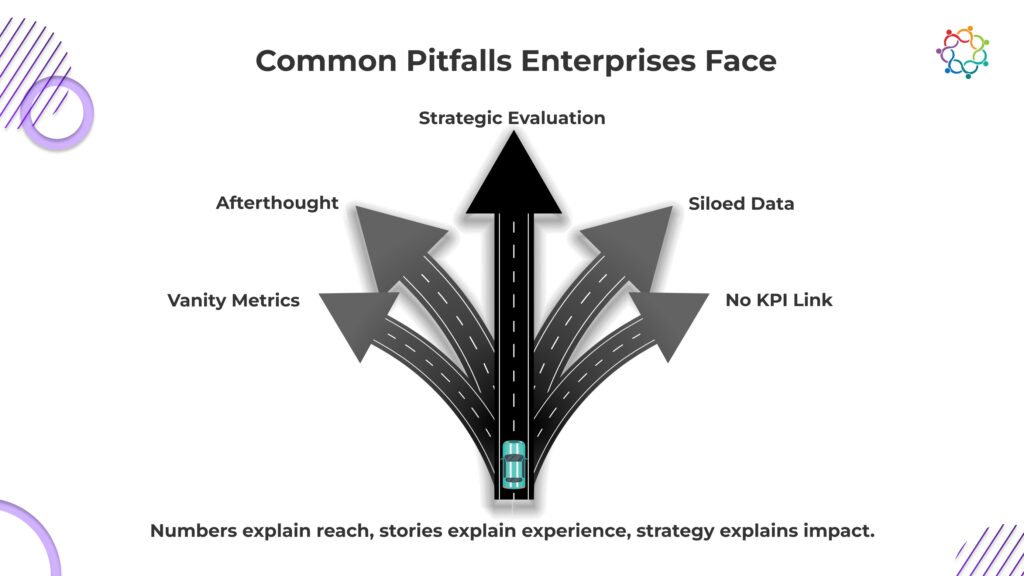
Even sophisticated teams struggle with evaluation. Common pitfalls include:
- Overemphasis on Vanity Metrics: Teams celebrate registrations, social likes, or footfall without linking them to business outcomes.
- Treating Evaluation as an Afterthought: Data capture begins only after the event, leaving critical information missed.
- Fragmented Data Across Teams: Marketing, sales, and operations maintain separate reports, preventing a unified view.
- Failure to Tie Back to KPIs: Reports focus on activity rather than impact, leaving leadership unconvinced of value.

Want to see how this would work for you?
Enterprise reporting at scale
See how Samaaro generates per-segment post-event reports for finance, marketing, sales, and C-suite.
Book a tailored walkthroughExample: A global consultancy celebrated “strong brand awareness” after an event, citing thousands of impressions on LinkedIn. But without evidence of how impressions translated into leads or deals, the claim carried little weight with executives.
Best Practices for Post-Event Evaluation
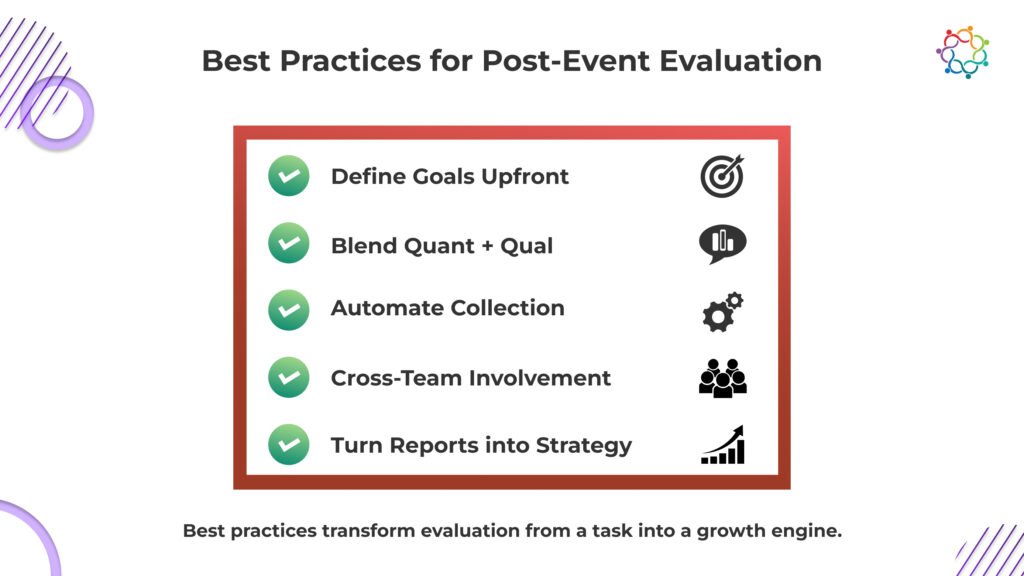
Enterprises that successfully do evaluations have some or all these best practices in common:
1) Define Goals Upfront
KPIs must be determined before sending out the invites. For example: is the event based around building pipeline, building thought leadership, or building deeper relationships with existing clients?
2) Combine Quant and Qual
You don’t have to choose between using numbers or stories only. Using both ensures measurement and actioning of insights.
3) Automate Data Collection
Manual and random statements are time-consuming and prone to error and misinterpretation. Having tools in place through CRM syncing, automating surveys and tracking engagements reduces friction for data collection.
4) Help Cross-Collaborate
When sales, marketing and operations evaluate post-event together, the insights gathered become richer and potentially more actionable. For example, sales may point out to marketing that they created some leads and prospects from an event, but the leads generated weren’t decision-makers. Operations teams will rarely get that insight through marketing metrics alone.
5) Strategic Recommendations from Reports
Your evaluation should not still be tied to your event unless you ended your evaluation with a clear list of recommendations: which channels were most effective, which personas were most engaged, and what needs to be fixed. You will apply these insights to the planning for the n
Samaaro Spotlight – Driving Enterprise-Grade Evaluations
Samaaro provides the tools enterprises need to streamline evaluation:
- Real-Time Dashboards → Leadership-ready data available during and after the event.
- Feedback Manager → Collects both structured survey data and open-text responses in one place.
- CRM Attribution → Directly links event touchpoints to deals and pipeline stages.
- Auto-Generated Reports → Produces tailored reports for executives, sponsors, and internal teams, reducing analyst workload.
For enterprise teams, Samaaro doesn’t just collect numbers, it integrates quant, qual, and strategic insights into a single framework.
Elevate Evaluation from Task to Strategy
Post-event evaluation is not just a task to complete. It should be both the strategic parameter that enables an event to convert from a stand-alone activity to a connector of growth.
- By leveraging more than just quantitative facts, specific qualitative stories and strategic alignment to the business, enterprises can:
- Demonstrate value and ROI to the sponsors and leadership
- Continuously optimize execution across events
- Align marketing expenditures to longer-range business objectives
While the closing session may signal the end of the event, evaluation begins the impact and at the same time signals the beginning of your next one.
Frequently Asked Questions
1. What is post-event evaluation, and how does it differ from simply reporting event metrics like attendance numbers and satisfaction scores?
Post-event evaluation is a systematic assessment of an event’s outcomes against the goals you set. It differs from reporting because reporting measures ‘the what’ (how many attended, what they rated) while evaluation measures ‘the so what’ (were they the right people, did the event move pipeline, was the cost justified). Reporting ticks boxes. Evaluation shapes strategy. Both matter, but enterprise teams under-invest in evaluation and over-invest in reporting.
2. Why is post-event evaluation especially critical for enterprise events where large budgets and multi-team collaboration are involved?
Post-event evaluation is critical for enterprise events because the budget is large enough that leadership wants accountability, and multi-team collaboration means many people need to see the verdict. Without evaluation, marketing celebrates impressions, sales counts leads, and finance asks ‘what did this cost us’. Evaluation reconciles all three perspectives into one defensible answer about whether the event delivered.
3. What are the three core components of post-event evaluation — quantitative, qualitative, and strategic data — and what unique insights does each provide?
The three core components of post-event evaluation are: quantitative data (numbers like attendance, revenue, NPS) that provides objective measurement, qualitative data (open-text feedback, themes, attendee quotes) that explains the why behind the numbers, and strategic data (pipeline influenced, brand lift, account engagement) that connects the event to long-term business outcomes. Quant proves it happened. Qual explains why. Strategic justifies the investment.
4. What are the most common pitfalls enterprises fall into when evaluating events, such as overemphasising vanity metrics or treating evaluation as an afterthought?
The most common pitfalls in enterprise event evaluation are: treating evaluation as an afterthought (only starting when the event ends), overemphasising vanity metrics like total impressions, fragmenting data across teams (marketing, sales, ops each running separate reports), and failing to tie back to KPIs set before the event. Each one weakens credibility. Leadership stops trusting event impact claims when reports lean on impressions without pipeline data.
5. How should enterprises define goals and KPIs before an event to ensure the post-event evaluation is meaningful and actionable?
Enterprises should define goals and KPIs before the event by answering: what is this event’s primary purpose (pipeline, thought leadership, customer retention, brand awareness), what specific KPIs will tell us we succeeded, and who owns each KPI internally. Write the KPIs down before invites go out. Without pre-event goals, evaluation becomes ‘here are some numbers’. With them, evaluation becomes ‘here’s what we promised, here’s what we delivered’.
6. How does cross-team collaboration between sales, marketing, and operations improve the quality and depth of post-event evaluation insights?
Cross-team collaboration between sales, marketing, and operations improves evaluation because each team sees a different angle. Marketing knows what worked in promotion. Sales knows which leads were real. Operations knows what broke logistically. When all three contribute to the post-event review, the insights are richer and the next event improves on multiple dimensions. Siloed evaluation produces partial answers and recurring mistakes.