

Why B2B Event Evaluation Needs Structure
B2B events aren’t simple standalone experiences. They travel along extended sales cycles, interact with multiple stakeholders, and layer objectives from lead generation to thought leadership to customer retention. Whereas with consumer events ticket sales or footfall might be the primary mark of success, B2B event success is multidimensional.
That is why having a structured evaluation process is essential. If event teams have no framework for evaluation, they have the risk of drowning in unconnected numbers and anecdotal feedback. But with a structure, marketers will be more effectively able to connect event performance back to business objectives, validate business ROI to leadership, and continually enhance strategy for future events.
You should think of evaluation as the last component of the event lifecycle, the connection between what you executed, and what you are going to do better next time.
Step 1 – Define Goals Before the Event
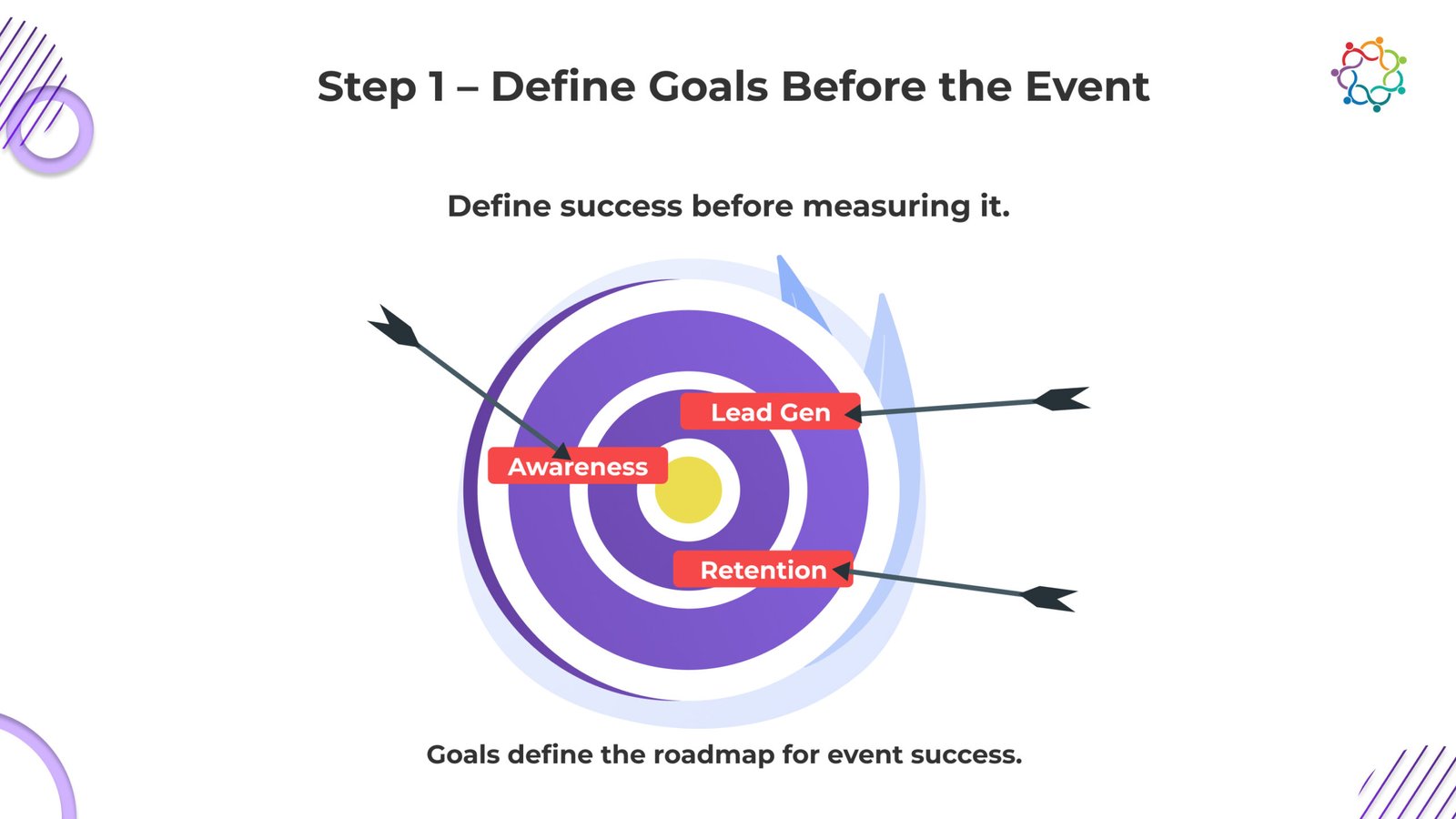
Evaluation doesn’t just start at the end of the event. It starts before you even promote. For the report to have meaningful impact, goals must be clear from the outset.
For B2B marketers, goals typically fall into three high-level categories:
- Lead Generation: Number of qualified leads add to the pipeline influenced accounts.
- Brand Awareness: Increasing reach into target industries, or geo-areas.
- Customer Retention/Expansion: Strengthening the bond with existing customers or accelerating cross-sell/upsell opportunities.
A clearly defined goal is your North Star. Without a clearly defined goal every metric becomes noise.
Step 2 – Collect Quantitative Data
Quantitative data will answer your “what happened?” It provides measurable, objective signals of performance.
The fundamental quant metrics to track for B2B events are:
- Registrations vs Attendees: How many said they were interested in attending and how many, in fact, showed up.
- No-Show Rate: A leading indicator of promotional effectiveness and your audience’s relevance.
- Leads Captured: All contacts added to your CRM with tags for account or persona.
- Revenue Attribution: Any deals influenced, pipeline created, and previous attribution for any revenue from event activity.
These numbers are a starting place for evaluation but as much as the data helps, it does not tell you why the impact what it was.
Step 3 – Gather Qualitative Feedback
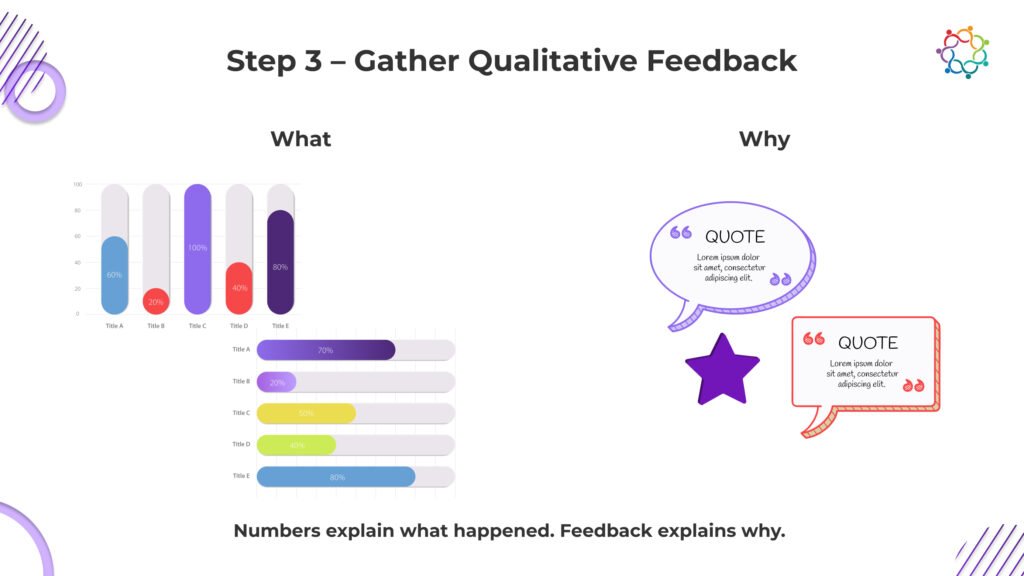
Data can indicate 300 attendees joined the webinar but only by way of qualitative feedback do you understand if it was thought of value.
Some core qualitative inputs are:
- Post-Event Surveys: How attendees rated their sessions, speakers and logistics/
- NPS (Net Promoter Score): Would they recommend this event to a colleague?
- Testimonials and open-text responses: Descriptive, unstructured data that demonstrates joy, frustration, or unmet needs.
- Internal Debriefs: Critical reflections/feedback that sales teams, operations staff, or partners apply to identify what worked or did not behind the scenes.
This feedback layer allows cold numbers to breathe and provide meaning. It adds human context to measurable outcomes.
Step 4 – Analyse and Interpret
This is where the process changes from collecting data to interpreting findings. Numbers without context can be misleading and stories without data can lead to bias in decision making. The most effective analysis combines quant and qual.
For example,
- Quant states, “60% of people who registered, dropped off before Session 3.”
- Qual states, “Survey comments indicated that the content was very technical and that it was paced poorly.”
So, both are providing clear and actionable advice: rethink the content design, for your technical sessions.
At this stage it is also important to reflect on the outcomes in relation to strategic targets. What was the impact on key accounts? What was the reach in target markets? Did you generate enough qualified leads to warrant the expense?
Step 5 – Document Lessons and Build Strategy
The last step in evaluation is not the report, it’s the playbook. I have tried to distil out lessons so that those lessons are not just captured in a file but rather are clearly understood lessons that will play in the next campaign.
Best practices in the playbook:
- Noted Replicable Wins: If you are using a certain format, for engagement, and it is producing results, make it part of your institutional practice.
- Noted Avoidable Lessons: If your last-minute promotional efforts had very little attendance, then make it a point that your campaigns must be rolled out well in advance of the event.
- Opportunities for learning to connect to strategy: What insights/discoveries/connections can you provide to enhance your overall ABM, content marketing, or regional event strategy?
This step is intended to take evaluation from a process to a system of ongoing improvement in that each event leads to a smarter next event.
Common Mistakes B2B Marketers Make
Even seasoned/practice teams experience challenges when evaluating their events. Some very common things not to do include;
- Only Collect Leads: Obviously total leads are good, but without any qualification filters those total lead counts can be misleading.
- Neglecting Qualitative Feedback: Numeric data lack context; you are missing that “why” factor without the voice of attendees.
- Measuring in Silos: Marketing reports on attendance; sales reports on leads; ops report on logistics. Without integration, the insights are all in separate silos.
- Divorced from Business KPIs: Reporting registrations when leadership wants to see influenced revenue is misalignment.
Avoiding these mistakes means that you are positioned to evaluate strategically, as opposed to superficially.
Samaaro Spotlight – Step-by-Step Evaluation in One Place
Evaluating using separate spreadsheets, survey tools, and CRM exports is not an efficient use of resources. Enterprises need a single system that can align steps accordingly.
Samaaro provides that:
- Automated KPI Dashboards: You get real-time readings on registrations, attendance, and engagement. It is at your fingertips without you having to ring in or wrangle data.
- Feedback Manager: Our Feedback Manager uses centralizes survey distribution, allows you to capture both quant (NPS, ratings) and qual (open-text) seamlessly.
- ROI Insights Incorporated into CRM: Event activity is linked directly to pipeline and revenue so CMOs have proof.
- Customizable Reports: Instant, export-ready insights that blend stories with numbers (typically for executives, sponsors and others).
Instead of amalgamating multiple data points, Samaaro provides a step-by-step evaluation framework in one platform making it easier for B2B teams to engage in systematic evaluation.
Structured Evaluation = Sustainable Success
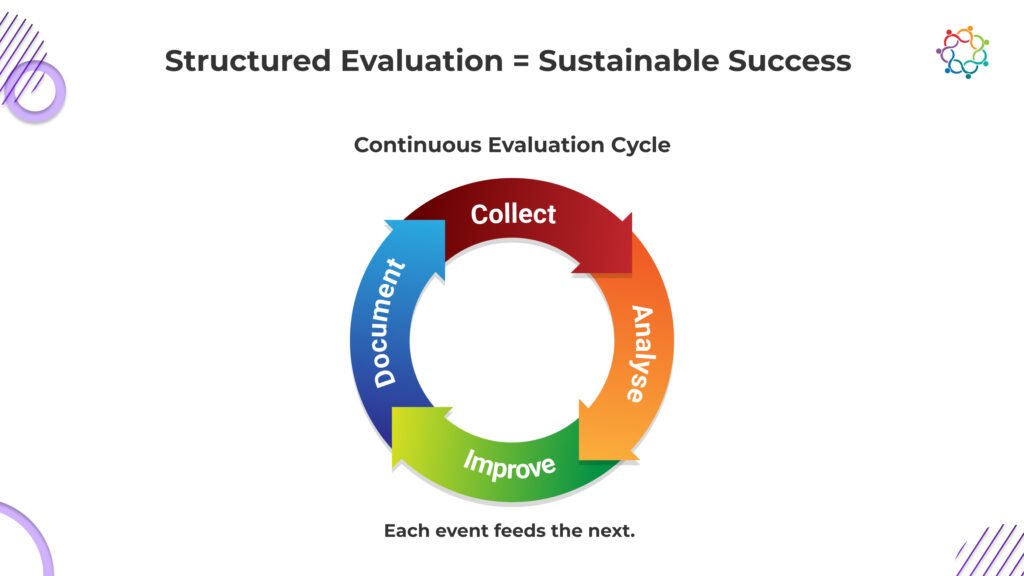
Event evaluation is not just a new step in the journey; it is the difference between one-off activities and a scalable growth engine.
For B2B marketers, a step-by-step evaluation framework:
- Provides clarity in linking event outcomes to business goals.
- Provides a full view of both quantitative and qualitative data.
- Records learnings that can amplify future action, work and strategies.
- Provides proof of ROI getting leadership buy-in for continuous investment.
- Structuring evaluation essentially reformats events into a replicable and repeatable growth engine.
Event and marketing teams can run outcome evaluations smarter, faster, and impactfully. So, that every event is not only successful but executes the enterprise strategy supporting that success.
Don’t want to build your own evaluation process? Ready-made evaluation frameworks are available in the form of a downloadable Post-Event Evaluation white paper or check out Samaaro’s analytics which every enterprise should consider.
Frequently Asked Questions
1. How should B2B marketers evaluate event success differently for a multi-touch ABM campaign versus a single standalone event?
For ABM campaigns, measure account progression across multiple touches over time. For standalone events, judge success against that event’s own goals, leads, and pipeline contribution.
2. What’s a reasonable timeframe to wait before attributing closed deals back to a specific event?
Allow at least one full sales cycle, typically three to six months in B2B, before finalizing deal attribution. Report early indicators sooner, but hold final ROI judgment.
3. What’s the difference between influenced pipeline and sourced pipeline when reporting event ROI to leadership?
Sourced pipeline means the event created a brand-new opportunity. Influenced pipeline means the event touched and advanced a deal that already existed. Report both, labeled clearly.
4. How can marketing and sales teams agree on a shared definition of a “qualified lead” before evaluating event success?
Agree on written criteria before the event: role, company fit, budget, timeline, and engagement level. Use one shared scoring model in the CRM so both teams count the same way.
5. What’s the best way to present a mixed-results event (strong attendance, weak pipeline) to stakeholders without downplaying either signal?
Present both signals honestly. Strong attendance proves your draw and targeting reach, while weak pipeline points to follow-up or audience fit issues. Pair each finding with a fix.