
The Marketing Dilemma
Each brand faces a budgeting question worth battling: Where should we allocate our marketing dollars to maximize our return? The decision is often between putting spending behind traditional campaigns (mass, digital ads) that have been historically used or investing in event marketing.
It’s a cyclical argument, with one delivering breadth of reach, while the other delivers depth of engagement. Generally, these informal arguments suggest that traditional ads are less expensive, while events are more expensive, but generate greater engagement.
In this blog, we’ll investigate the true value proposition of event marketing vs traditional marketing, clearly rationalizing how forward-thinking brands should structure these considerations to optimize verifiable trust, and measurable ROI.
For a deeper understanding of how event marketing strategies are evolving with data and technology, explore “Event Marketing 2025: Strategies That Deliver Real Results”. It offers actionable insights on aligning events with measurable business outcomes and audience engagement goals.
Traditional Marketing – Strengths and Weaknesses
Traditional marketing refers to anything that is designed to reach a mass audience, whether through traditional television and print or programmatic display ads in digital form.
Strengths: The chief strength of traditional marketing lies in its Reach. Traditional channels, specifically mass media and targeted digital ad networks, enable brands to plan a message with the potential to reach millions of consumers immediately. Thus, it is well suited for broad brand awareness and product launches.
Weakness: Despite the mass reach, traditional marketing channels will, no doubt, struggle with two significant factors in 2026 – limited consumer trust and excessive ad fatigue. Consumers are inundated with vague, traditional advertising, and their trust has plummeted.
The consumer may see your banner ad or sponsored post in their feed, but seeing a paid advertisement or brand talking about their own business is rarely enough of an emotional connection or relationship to build the trust needed for a higher-value consumer conversion.
Event Marketing – Why It’s Gaining Ground
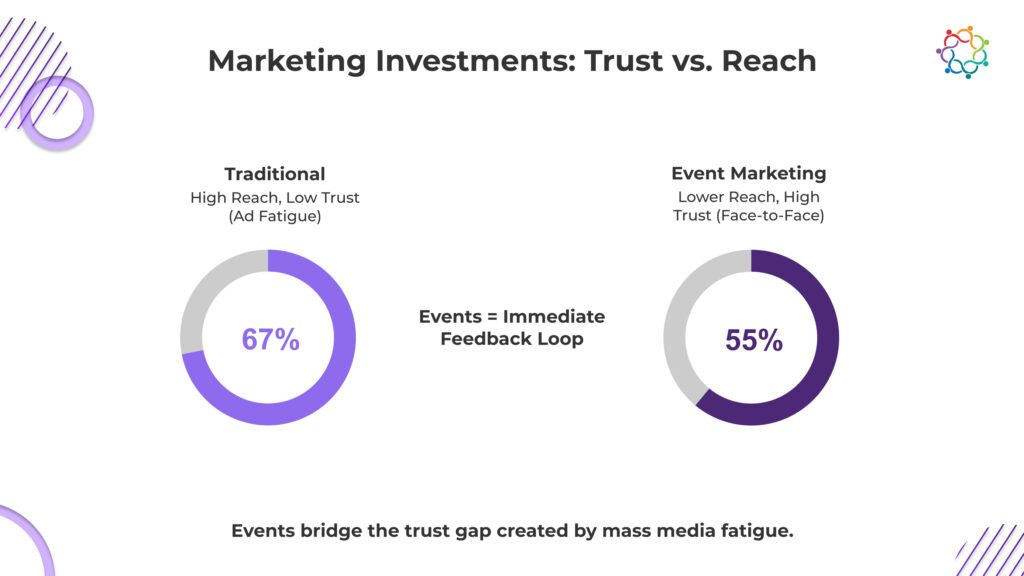
Event marketing is on the rise because it offers the exact antidotes to the shortcomings of traditional marketing, trust, context, and immediate feedback.
- Builds Trust Through Face-to-Face Interaction: An event, whether virtual or in-person, is a designated time block when an attendee chooses to spend time with your brand. This is a shared experience that creates authenticity and builds trust very quickly.
- Personalization + Immediate Feedback Loop: You can customize content, networking opportunities, and sales follow-up based on an attendee’s role or interest for truly unprecedented personalization. And unlike digital marketing, events provide an immediate feedback loop through Q&A, polls, and direct conversations allowing you to measure sentiment and adapt your pitch in the moment.
Example: A major BFSI (Banking, Financial Services and Insurance) brand indicated that while digital advertising generated a high quantity of leads, their quarterly investor meets using proprietary content and one-to-one getting provider sessions, were responsible for driving much higher-value commitments and long term client loyalty.
ROI Comparison – Events vs Traditional
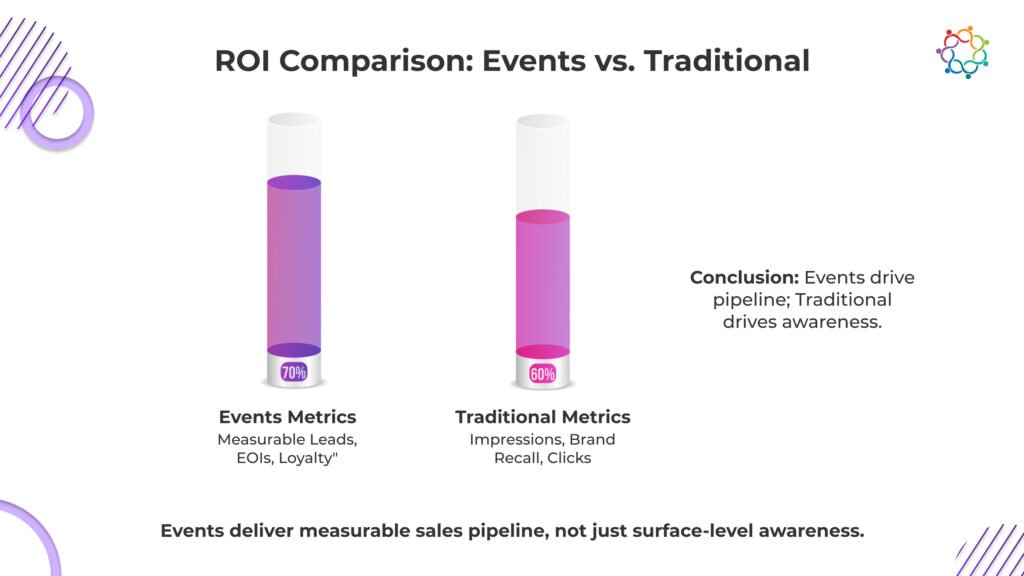
The most critical difference lies in what each channel measures and how that translates into verifiable ROI.
| Metric Type | Traditional Marketing | Event Marketing |
| Output Focus | Impressions, Clicks, Brand Recall | Measurable Leads, EOIs, Deals |
| Data Quality | Surface-level (anonymous clicks) | Deep-level (role, intent, session attendance) |
| Pipeline Impact | Primarily Top-of-Funnel (Awareness) | Mid-to-Bottom-of-Funnel (Conversion & Sales) |
| Trust Factor | Low | High |
Traditional marketing primarily generates awareness, metrics that are far removed from revenue. Events, however, generate traceable actions like Expressions of Interest (EOIs), demo requests, and signed deals. You can draw a direct line from an attendee’s registration and session attendance to their progression through the sales pipeline, making the ROI of event marketing significantly more transparent and defensible.
Future Outlook – Hybrid Investments in 2026
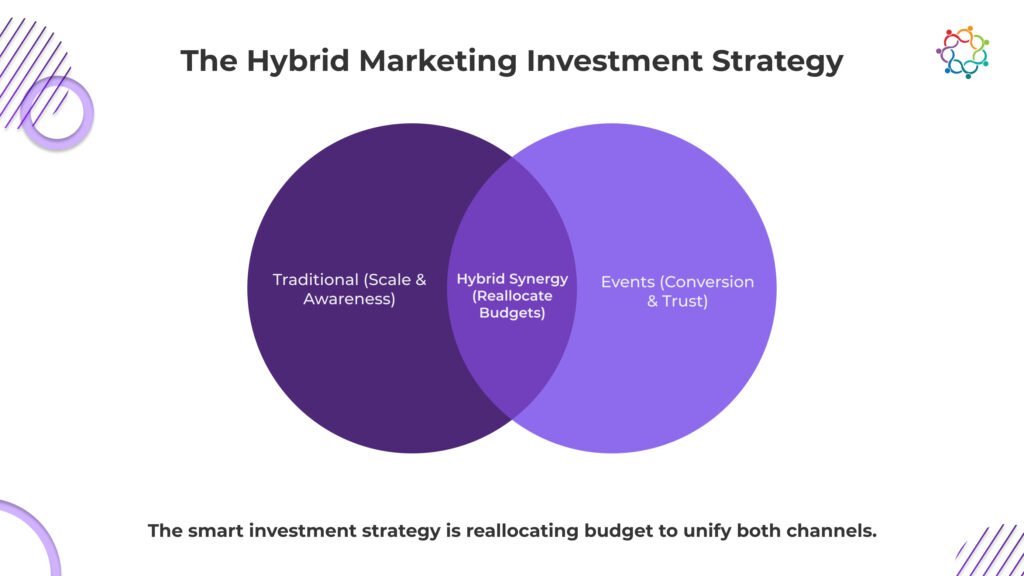
The most astute marketing investments for 2026 will not be made in one channel or another, but in the hybrid synergy of both.
Brands must realize that employing events vs. a digital campaign will not be competitors; they will be complements. Traditional digital channels are still vital for top of funnel broad based awareness, general interest in your brand and registrations in your event funnel.
Next, the event serves as your high-trust high conversion mechanism to convert those leads (exhibitors, attendees, partners, sponsors) into pipeline, and then post event, digital follow up creates retention.
In the future we all will have to strategically and budgetarily pull away from broad underperforming awareness ads to budget more into the technology that enables event data to be traceable to action.
Samaaro Spotlight – Proving ROI of Event Marketing
To support the case for shifting budget towards events, Samaaro provides a robust marketing ecosystem that transforms event spend into measurable, revenue-oriented outcomes:
- Multi-Channel Campaign Engine: Plan, personalize and automate outreach across email, SMS, WhatsApp, and IVRS, all from one dashboard. This means your event promotion isn’t confined to a single medium but meets attendees where they are.
- Advanced Segmentation & Behavioral Targeting: Build targeted lists (by role, interest, behavior), trigger messages based on attendee actions, and tailor content dynamically. This elevates the promotion from generic to highly relevant.
- CRM & Marketing Stack Integration: Seamless sync with your existing CRM and analytics tools ensures the data from your event campaigns flows straight into your sales pipeline – no data silos.
- Real-Time Performance Visibility: Track opens, clicks, conversions and registrations live; gain 360° visibility of how your campaign is performing across channels. This supports data-driven decisions mid-campaign or mid-event.
- ROI & Expense Analytics: Export budget reports, monitor variance, link spend to registrations/attendance, and get clear cost-per-attendee insights to support the business case for future events.
- Automation to Reduce Manual Work: Automated scheduling, reminders, calendar-add-ons and workflow management cut down manual labour, freeing your team to focus on high-value interactions instead of repetitive tasks.
By harnessing these capabilities, Samaaro helps brands go beyond “just doing an event” to treating each event as a growth asset, with measurable touchpoints, conversions, and pipeline impact.
Smart Investments Balance Both, but Events Win Trust
The marketing issue is not resolved by selecting one channel or the other, but rather by assigning them the correct role. Traditional marketing casts a wedge, but in 2026, event marketing is the trusted engine of growth that catches the most valuable, high-intent leads. Savvy brands know that trust is the currency of conversion.
Want to get the capabilities to maximize ROI from events? Check out Samaaro’s marketing attribution tools.
Frequently Asked Questions
1. How should brands split their marketing budget between traditional and event channels in 2026?
There is no universal split, but many B2B brands now put 30 to 40 percent into events, with the rest across digital and traditional channels, adjusted by audience and goals.
2. Why do EOIs (Expressions of Interest) matter more than impressions when tracking marketing performance?
Expressions of interest signal real buying intent you can act on: a person raised their hand. Impressions only mean someone possibly saw your ad while scrolling.
3. How can a brand measure the trust factor generated by an event compared to a traditional ad?
Compare brand trust survey scores, meeting acceptance rates, and conversion speed for event contacts versus ad-generated leads. Face-to-face interaction consistently builds trust that ads cannot match.
4. What’s the best sequence for using digital ads and events together in a single campaign funnel?
Run digital ads to drive event registrations, use the event itself to build trust and convert, then retarget attendees with follow-up campaigns. Each channel amplifies the other.
5. What’s the difference between top-of-funnel and mid-to-bottom-of-funnel marketing channels?
Top-of-funnel channels build broad awareness among people who do not know you yet. Mid-to-bottom-funnel channels, like events, nurture interested buyers and convert them into real pipeline