

Why One Evaluation Method Is Never Enough
Your event is over. The last session has concluded, the lobby is quiet, and now the big question is – was it a success? For many teams, the answer is boiled down to one KPI, a total attendance number, or a quick NPS (Net Promoter Score). But events are layered, complicated experiences. Focusing on only one metric creates a flat incomplete picture; it leaves you with more questions than answers. You may have clarity on what happened, but you are not sure why, and furthermore, what it means for the future.
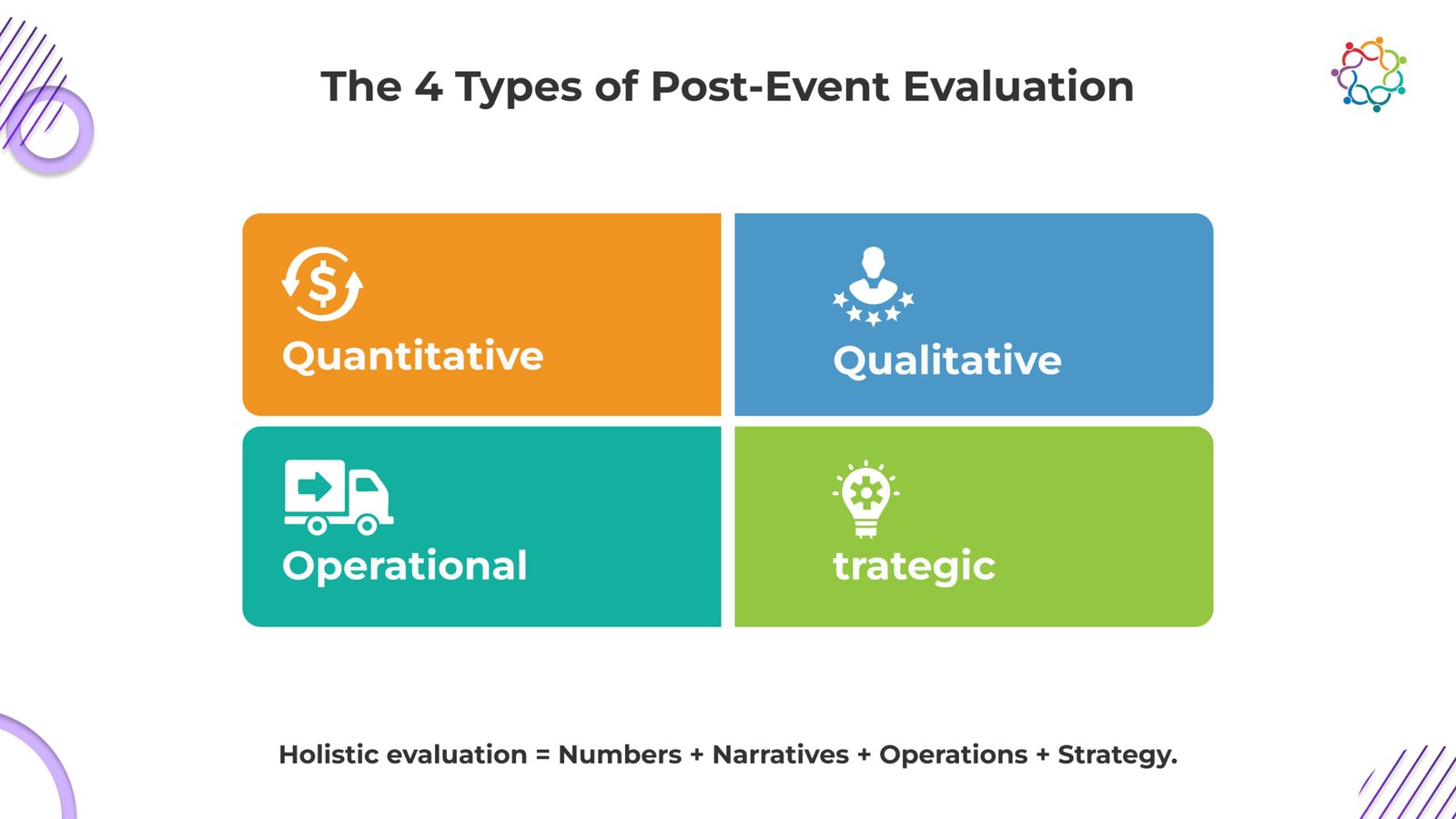
This is the reason a holistic approach to post-event evaluation is so important. It requires taking the event experience one step further and viewing it through multiple lenses. By identifying and applying the four main types of post-event evaluation, you can clarify your evidence from a complete picture; one that is not only going to help you determine your next steps but also increase your chances of securing budget next time and demonstrate the overall value of the experience. This blog will breakdown the various methods of event evaluation, outlining when and why one will be an important piece of your event reporting framework.
Type 1 – Quantitative Evaluation
Quantitative evaluation is likely the most well known and easiest to process of the four assessment types. Quantitative evaluation simply deals with numerical data and measurable outputs. This is where the heavy, data-based data deals have started. These are things you can count. This information is objective, comparable, scalable, and directly measurable to consumers, stakeholders, and executives.
- Examples: This may be hard metrics such as total registrations, attendance, final attendance, total clicks from promotional emails (click through rate = CTR), dollar value in pipeline from your event, and so forth. This may also include scores such as NPS (Net Promoter Score), or a final out of 5 score.
- Strengths: A quantitative evaluation provides an objective view of your event performance and often offers times a simple black-and-white, or all-or-nothing perspective. The data can also be based by benchmark standards against other events or industry standards, making this extremely valuable to demonstrate success with objective information.
- Best Use Case: A quantitative evaluation is your best friend when preparing ROI reports/results for leadership, sponsors, or investors. Offering numbers, that people can comprehend to justify the expense of your event, and demonstrating the events financial impact relies heavily on quantitative reports/metrics.
Type 2 – Qualitative Evaluation
Quantitative data tells you what happened, while qualitative evaluation tells you why. This method seeks the stories, feelings, and perceptions of attendees, adding a human context to that data. It allows you to actually hear from your attendees in their own words and provides additional insights that data cannot illuminate.
- Examples: It can be open-ended survey questions such as, “what was your biggest takeaway from the event?” and “how did this event make you feel?” It can include testimonials, as well as candid conversations with attendees and reflection from your internal event team.
- Strengths: Qualitative feedback is extremely rich and valuable. It can help you understand the feelings of your attendees, identify pain points, and areas of delight that contributed to the positive experience.
- Best Use Case: Qualitative event evaluation methods are best applied when trying to improve the design of the attendee experience and messaging for future events. The insights gathered can clearly inform your content strategy, speaker selection, and tone for the overall event.
Type 3 – Operational Evaluation
Operational evaluation is an internal evaluation process that focuses purely on your event’s logistics including how it was executed. The goal of operational evaluation is to establish what was executed well and what wasn’t, so your team can learn from the experience so that they can inform capability and refine the process for the next event.
- For example: Operations evaluation could include looking at how efficient the venue management was, how easy and quick check-in was for your participants, how many technical issues, if any, were encountered, and how well vendors were coordinated. So operational evaluation is based on the process of putting on the event.
- Advantages: This type of evaluation is so valuable because it can help to identify the gap in level of delivery and operational process. Most importantly, it will give you a documented roadmap or blueprint, on the logistical flow of your next event, making it simpler to everyone ma having as little impact on everyone as possible.
- Best use case: Operational evaluation is critical to informing internal teams and having data driven decision making in future vendor selections and purchasing software.
Type 4 – Strategic Evaluation
Strategic evaluation looks at your event holistically and examines the longer-term outcomes. It connects the event to higher-level business objectives. The focus is on the change in impact and lasting influence the event had, as opposed to short-term outcomes. Strategic evaluation is the most developed and therefore most challenging type of post-event evaluation, as it may be difficult to establish during the engagement level of an event.
- Examples: Includes brand lift or brand perception change, moving the needle on key accounts, creating new business relationships, and analysing the impact on your business level. It answers questions regarding how the event moved the needle on your overarching objectives.
- Strengths: A strategic evaluation position is very beneficial for linking your event back to overarching brand/marketing objectives post-event, supporting existence in the annual budget, and supporting the storytelling frame of reference for the CMO’s reporting.
- Best Use Case: This framework is utilized to demonstrate the longer-term benefit of events and define them as a part of your business development growth strategy.
How to Decide Which Type to Use (and When)
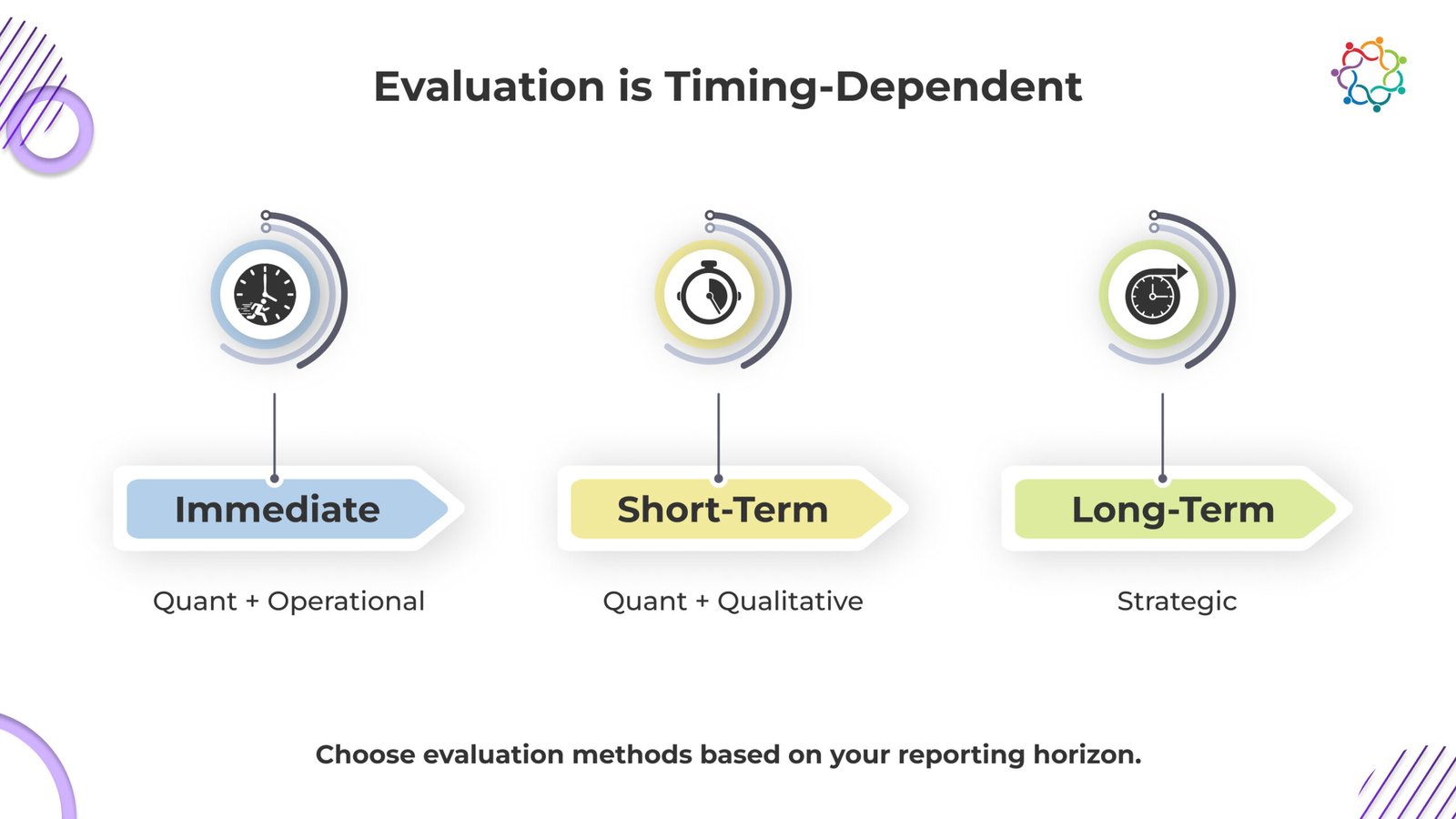
The best approach to evaluation is to take a blended approach to evaluation, depending on your goals and schedule. No single event evaluation approach will suffice alone. Here is a very simple approach to take:
- Immediate (During & Right After the Event): Think about the immediate evaluation as a blend of operational and quantitative evaluation. Look at participation levels: attendance to sessions and average check-in time, for example. Get quantitative data immediately with quick in-platform polls or surveys to obtain qualitative sentiment and engagement monitoring through chat channels.
- Short-term (1-2 weeks post-event): This is a great typical opportunity to focus on a balanced mix of qualitative and quantitative evaluation. Send an expansive survey to the attendees with both open-response and multiple-choice questions and get both quantitative data and qualitative narrative behind it.
- Long-term (3-6 months post-event): Here is where you’ve breakout the strategic evaluation work. Now you can assess the real business impact; did leads move through the funnel, what is the change in brand sentiment, were long-term relationships established that were of value to your organization to know the true return on your event success.
The best practice is to always take a blended approach to these types based on your specific goals. For instance, if you are trying to demonstrate ROI, you will need both quantitative data on pipeline generated, and qualitative feedback from sales teams on the quality of leads, to be able to provide a compelling full-circle story.
Case Example – A B2B Conference Evaluation Mix
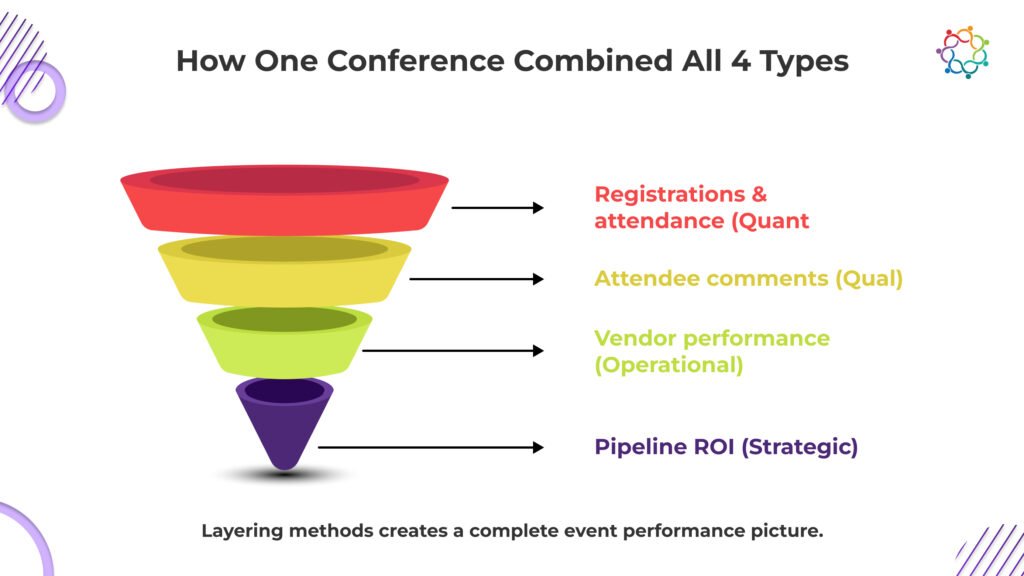
Now imagine a B2B event that used the universal evaluation framework. The team did not just use the evaluation to investigate the 1,500 participants but designed their evaluation to identify the full context.
- Quantitative Outputs: The registration document identified a 25% year on year increase, and the post-event survey showed speaker satisfaction of 4.5/5. The final document from their CRM showed the event generated $50,000 in pipeline from attendees before the event which can be considered the hard ROI number.
- Qualitative Outputs: The open-ended questions in their survey, identified that attendees loved the small networking groups, but expressed discontent with the audio quality at the main stage. The testimonials included in the report were strong for one keynote speaker and the team could use to help promote the next event.
- Operational Outputs: After the event when the evaluated the event as a team, they identified the check-in took too much time, and at times their primary A/V vendor acted slow. It would help them closely consider their vendor selection for this year’s event.
- Strategic Outputs: Three months later, when the marketing team reported a 10% increase in branded search queries and two major enterprise prospects moved from “lead” to “opportunity” after their marketing team participated in the event, that’s the strategic value right there.

Want to see how this would work for you?
Automate post-event evaluation
See how Samaaro turns raw event data into the four reports your stakeholders actually want.
Book a tailored walkthroughSamaaro Spotlight – Supporting All 4 Types of Evaluation
Samaaro’s platform is built to be an all-in-one platform that facilitates every type of post-event evaluation. Our strong tools push you beyond the basics so that you can gather a more complete picture of your event’s outcome.
- Quantitative Dashboards: Immediately access registration, attendance and even lead conversions with our dashboards. Our dashboards provide a full description of what hard data you have in order to assess your reporting on ROI.
- Feedback Manager: Gathering qualitative answers is enhanced with customizable polls and open-ended surveys; we even leverage analysis of real-time chat from discussions to help provide further insights into participant sentiments and pain points.
- Operational Analytics: Identify operations gaps in your execution by getting a detailed breakdown of check-in times, session attendance, and even technical performance.
- Strategic ROI Insights: Our deep integrations with leading CRMs such as HubSpot, Salesforce, GRM etc., allow you to create a pathway from event engagement to pipeline and sales progression – the ultimate justification to make strategic use of your events.
Evaluate Broadly, Improve Holistically
In an era of flawless marketing accounting, it’s crucial that your event evaluation practices are as sophisticated and multi-dimensional as your events are. By only measuring a multi-dimensional experience by one key performance indicator (KPI), you are underestimating the potential insights. Enter the realm of all four event evaluation types – quantitative, qualitative, operational, and strategic – and you will leave an event with a full circle understanding of the performance of your event.
Using a full circle approach will not only help you demonstrate the value of your previous events, but it will also provide the actionable intelligence needed to design and implement future events that are more successful, impactful and relevant to the business objectives of your organization.
Ready to learn about a full circle evaluation framework, download our Post-Event Evaluation white paper, or learn about Samaaro’s evaluation tools that do it all.
Frequently Asked Questions
1. What are the 4 types of post-event evaluation and how does each one differ from the others?
The 4 types of post-event evaluation are: quantitative (the numbers, like attendance and revenue), qualitative (the why, like attendee quotes and themes), operational (the execution, like vendor performance and check-in efficiency), and strategic (the long-term impact, like brand lift and pipeline influence). Quant tells you what happened, qual tells you why, operational tells you what to fix, and strategic tells you whether the event served the business. Each one answers a different question.
2. When is quantitative evaluation the most effective method to use in post-event reporting?
Quantitative evaluation is most effective when you need to justify budget, prove ROI to executives or sponsors, or benchmark against past events. Numbers give an objective view that’s hard to argue with. Use quantitative when reporting to CFOs, board members, or finance teams who want a clear value-for-money answer. Quantitative also forms the foundation that qualitative and strategic insights build on.
3. What kinds of qualitative data should event teams collect to better understand attendee experience and sentiment?
The qualitative data event teams should collect includes: open-text survey responses, NPS comments, attendee testimonials, sponsor and speaker feedback, social media sentiment around event hashtags, and internal team debrief notes. Qualitative is the ‘why’ behind your numbers. A 70 percent attendance rate without context is just a stat. The qualitative reveals whether attendees loved the content, struggled with check-in, or felt the networking was thin.
4. What does operational evaluation focus on, and how does it help improve future event execution?
Operational evaluation focuses on execution: how check-in performed, whether vendors delivered on time, how the on-site team handled issues, where logistics broke down, and what staffing levels worked. It helps improve future execution by surfacing specific fixes (like ‘check-in took too long with one queue, add three next year’ or ‘A/V vendor was slow, evaluate alternatives’). Operational insights are usually action-ready within days of the event.
5. How does strategic evaluation connect an event’s outcomes to long-term business objectives?
Strategic evaluation connects an event’s outcomes to long-term business objectives by tracking outcomes that take weeks or months to surface: pipeline influenced, branded search lift, deals accelerated, customer retention from attendees, and entry into new accounts. It’s the evaluation that defends event marketing in next year’s budget conversation, because it links the event to revenue and growth, not just attendance numbers.
6. How should event teams decide which combination of evaluation types to use at different stages — immediately after, short-term, and long-term post-event?
Use operational and quantitative evaluation in the first 48 hours, while details are fresh. Run qualitative evaluation in the first 2 weeks once survey responses come in. Conduct strategic evaluation 60 to 90 days later, when pipeline and revenue attribution are clear. A blended approach gives you a complete picture. One evaluation at one point in time always misses something.
7. What are the 4 types of post-event evaluation and when to use each one?
The four types are quantitative, qualitative, operational, and strategic. Quantitative is the numbers, like attendance and revenue. Qualitative is the why, drawn from attendee comments. Operational looks at how smoothly the event ran. Strategic looks at long-term business impact. Use them together, since each one answers a different question about your event’s success.
8. What is quantitative evaluation and what numerical data does it measure for events?
Quantitative evaluation deals with numbers and measurable results. It tracks things you can count, like total registrations, attendance, email click-through rates, pipeline value, and scores such as NPS or a rating out of five. This data is objective and easy to compare against other events, which makes it perfect for proving ROI to leadership, sponsors, or investors.
9. How does qualitative evaluation differ from quantitative evaluation in post-event assessment?
Quantitative tells you what happened, while qualitative tells you why. Qualitative evaluation captures stories, feelings, and opinions through open-ended survey questions, testimonials, and conversations with attendees. It adds the human context that numbers miss. For example, data shows people left a session, but qualitative feedback explains they found it too advanced. You need both for a full picture.
10. What is operational evaluation and how does it focus on event logistics and execution?
Operational evaluation is an internal review of how well your event actually ran. It looks at practical things like how smooth check-in was, whether vendors performed, how many technical issues popped up, and how well the venue was managed. The goal is to spot what worked and what did not, so your team can run the next event more smoothly.
11. What is strategic evaluation and how does it examine longer-term event outcomes and business objectives?
Strategic evaluation looks at the bigger, longer-term impact of your event. Instead of short-term numbers, it tracks things like brand lift, movement on key accounts, and new business relationships. It connects the event to your wider business goals. It is the hardest type to measure because results take time, but it is what justifies events in next year’s budget.
12. Which type of post-event evaluation is best for demonstrating ROI to stakeholders?
Quantitative evaluation is best for proving ROI to stakeholders. Numbers give an objective, hard-to-argue answer that finance teams and sponsors understand. Things like cost per attendee, leads generated, and pipeline value show clear value for money. For the strongest case, pair these numbers with strategic evaluation, which links the event to long-term revenue and growth.
13. Why is a blended approach to post-event evaluation more effective than using just one type?
No single type tells the whole story. Numbers alone miss the human reasons behind them, and feedback alone has no hard proof. A blended approach combines all four types, so you understand what happened, why, how it ran, and what it meant for the business. For example, proving ROI needs both pipeline numbers and sales feedback on lead quality.
14. How do qualitative evaluation methods capture attendee stories, feelings, and perceptions?
Qualitative methods let attendees speak in their own words. You use open-ended survey questions like what was your biggest takeaway, collect testimonials, and gather candid conversations and reflections from your team. This reveals how people actually felt, what delighted them, and where they hit pain points, giving you rich insight that a simple score or number could never show.
15. What questions should you ask in operational evaluation to identify what was executed well or poorly?
Ask practical questions about how the event ran. How long did check-in take? Did vendors deliver on time? Were there technical glitches? Was the venue managed well? Did staffing levels work? These questions surface specific fixes, like adding more check-in lines or switching an unreliable vendor, so your next event runs more smoothly. Operational answers are usually ready within days.
16. How does strategic evaluation connect event performance to higher-level business impact and lasting influence?
Strategic evaluation traces the event’s effect on outcomes that take weeks or months to appear, like pipeline influenced, branded search lift, deals accelerated, and entry into new accounts. It links the event to revenue and growth rather than just attendance. This is the evaluation that defends event marketing in budget conversations, because it proves lasting business value.