
Big Impact Doesn’t Always Require Big Budgets
The myth that you can only have a successful event promotion campaign with a large ad budget is an ongoing one. Many event teams (especially teams/individuals at startups, or small to medium-sized businesses) often feel they cannot compete with bigger brands. However, creativity, strategic use of your owned assets and perseverance will help you achieve an incredible return on investment, even with a ridiculously low spend.
Stop thinking about running out of funds as a limitation and conditioning your mind to think in terms of innovation. This guide will act as a play book of sorts for running an event promotion campaign; hopefully you will see that smart planning and clever tactics can be better than large ad spend!
We’re going to explore high value, low-cost event marketing ideas for reaching the right audience without a large investment! We will cover ways to use your existing networks, find great partnerships, and implement marketing tactics to maximise rock-bottom cost for your event promotion.
Leverage Internal Channels First
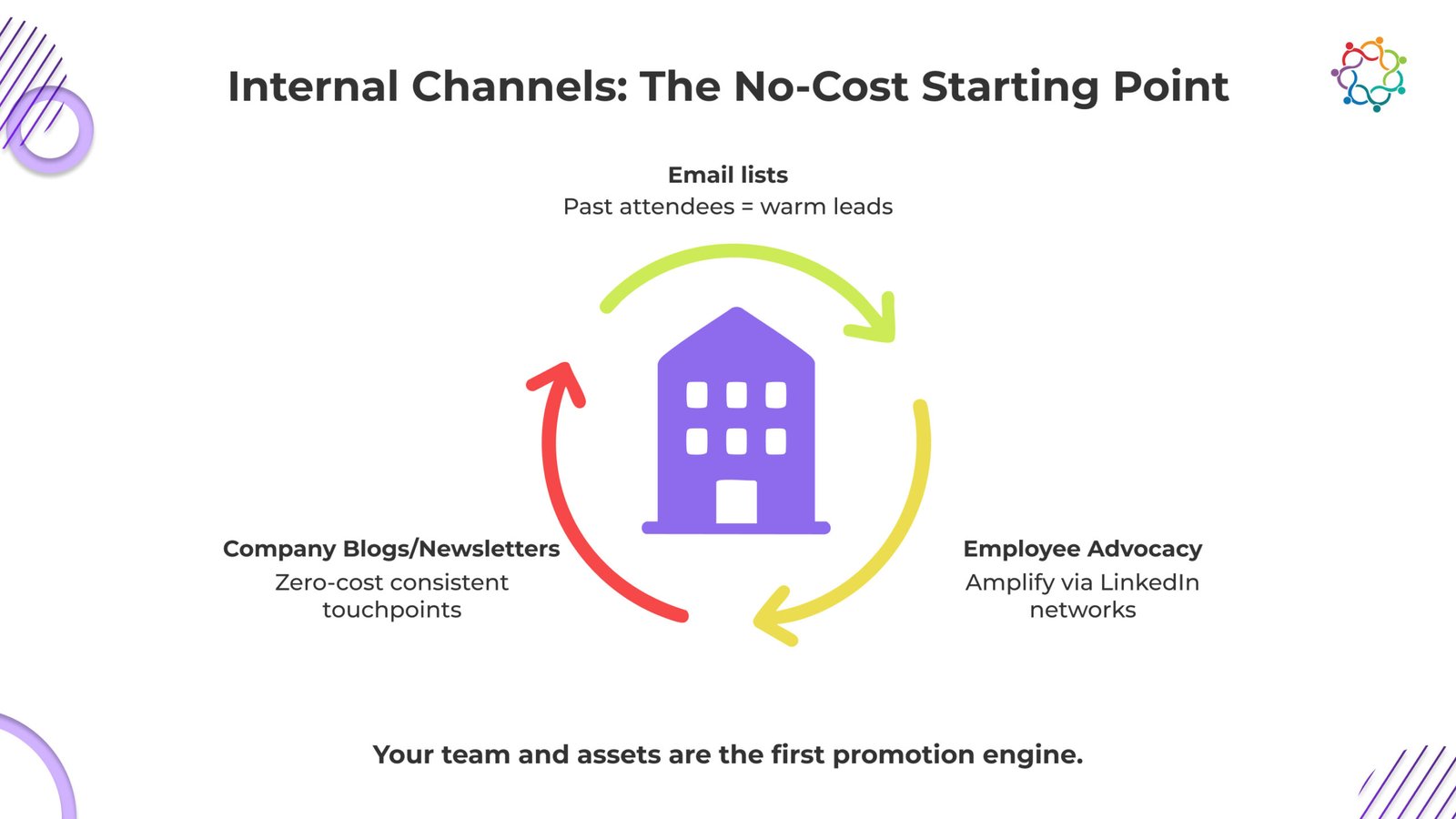
Before you spend money on any paid advertising, take a look at resources you may have available to you, right now. The biggest promotion power has, and likely always will be, your own assets, channels, and resources, and they are often free! These established channels come with built-in trust and a captive audience to promote your event in a cost-efficient manner.
- Email Lists and Past Events Attendees: The absolute best audience that you have is your existing email subscribers, past attendees, and likely some warm prospects. Prospects who have expressed interest in your brand will be more receptive with any messaging you send them, so use targeted drip campaigns to nurture your email lists, share sneak peeks, speaker announcements, and exclusive content to convert them into registered attendees.
- Employee Advocacy: As an aside, consider how you can get your employees to be brand ambassadors for your event. Many employees will freely share and advocate for your event with their networks and on platforms like Linked In. Most times, these networks are hi trust, and more influential. If you can share and provide content that is easy to share, social media copy you provide, along with a trigger related call to action, employees can be a multiplier for organic reach.
- Company Newsletters / Blogs: You have several opportunities to use in your regular communications and /or content platforms. From company newsletters, and similar, if you regularly publish and distribute company’s newsletters. Newsletters are perfect for an event announcement, so of course hopefully you will promote your event very well in your conventional newsletter. For blogs, you can utilize your blog to publish a series of posts to highlight speakers, delve into themes and details of your event, behind the scenes, etc. This serves to market your event but is also beneficial to reinforcing your overall content strategy.
Organic Promotion That Pays Long-Term
Organic promotion means making content and creating thriving communities without the intention of achieving reach explicitly. Organic promotion will take time, but the long-term impact on your brand and the audience is worth it.
- SEO Content Around Event Topics: Build a pillar page or a series of blog posts targeting long-tail keywords associated with the topics at your event. For example, if the overall event is focused on “marketing analytics,” create a content piece about “how to analyse marketing data,” where “marketing data” links back to the event. Creating SEO content helps you rank higher, opens your search visibility, and gets you in front of the audience with high intent.
- Speaker-Led Thought Leadership: Connect with your speakers to write thought leadership posts that cover their session topics on their platforms. In addition, it can help open doors to their networks or build engagement and credibility for your event.
- Behind-the-Scenes Content: Share realest team member content on social media! Share your staff working away, speakers, rehearsing, or exclusive previews of the venue. Building more authentic content can bring more excitement, community, and accessibility.
- Social Media Groups/Niche Communities: Rather than broadcasting to all, try to connect directly in desired resonant niche community and social media groups where the audience you want to connect with is already congregating. There are often very few obstacles for you to solve their problems by providing value and information, mention or reference your event as a solution to their unanswered queries.
Partnerships as Promotion Multipliers
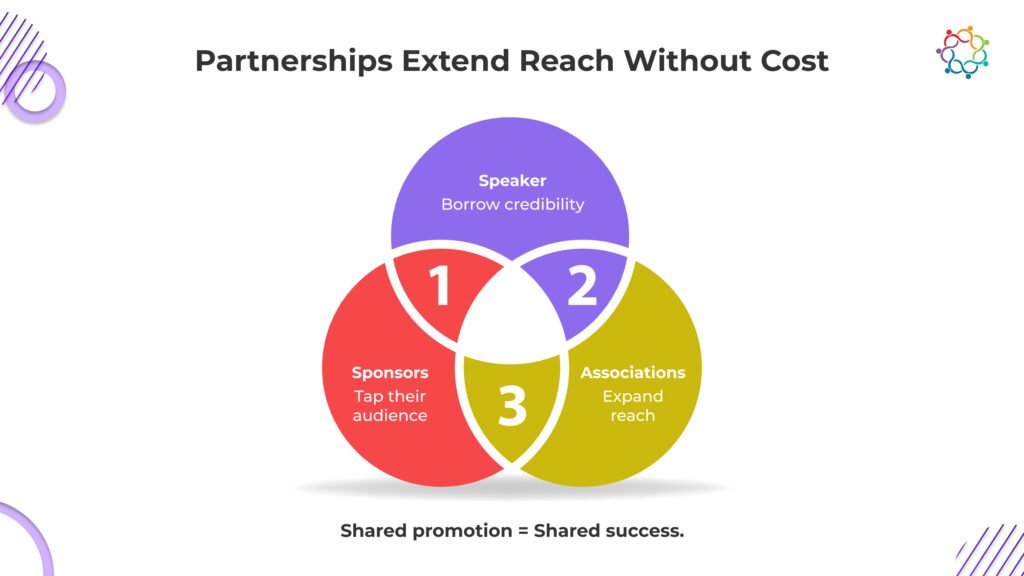
Strategic partnerships are great and inexpensive ways to promote an event that can create a viral campaign out of one promotion. By tapping into the reach of others, you can engage a greater audience with much less expense.
- Sponsors Are Promotion Partners: Your sponsors make natural partners in promotion. Ask them to promote the event to their own audience as part of the sponsorship agreement. This provides them with some lead generation opportunities and provides you access to their audience.
- Lock-In Amplifier – Speaker Networks: Your speakers can be powerful amplifiers. They provide influence and networks of people who know them. Provide them with a simple promotion kit with social media graphics, pre-written email copy, and recommendations for promoting/talking about the event and a unique registration page to track their effectiveness.
- Industry Associations: Connect with industry associations or media who have an audience of your target customer. A very simple co-marketing agreement: you promote their content, and they support your event can be an easy way to enhance credibility and gain an audience who is relevant for your event.
- Co-Marketing Exchanges with Non-competing Brands: Find brands who target the same customer but are not direct competitors to your brand. A co-marketing partnership could be as simple as hosting a webinar together, a joint social media campaign, or a simple newsletter exchange that costs nothing but time.
Cost-Effective Paid Tactics (If You Must Spend)
Small budgets can have big impacts with an effective small spend. The good thing is you get to spend smart and not spend broadly and unfocused.
- Very targeted LinkedIn Ads: For B2B events, LinkedIn allows you to target by job title, industry, and size of company. A small campaign with high relevance and minimal waste can be accomplished for event marketing through LinkedIn. Prequalified target market!
- Google retargeting: Retargeting is also a small, low-cost, high intent tactic. You are only serving ads to people who have already visited your event website. Since they are already aware of your lead time and attraction tactics, your conversion cost will be significantly reduced.
- Sponsored posts in niche newsletters: Is there a newsletter in your niche or industry that has engaged subscribers? Run a sponsored post or a featured spot. A good return from their investment is possible on a relatively low investment, since you already know your target audience are interested in the content they are paying to consume.
- The Golden Rule: The golden rule with small budget paid advertising is simple (not easy): spend small, spend smart, measure everything. Tracking so that you can measure your target granularity and transparent ROI measurement channels will be imperative in making informed decision as you move forward.
Creative Guerrilla-Style Ideas
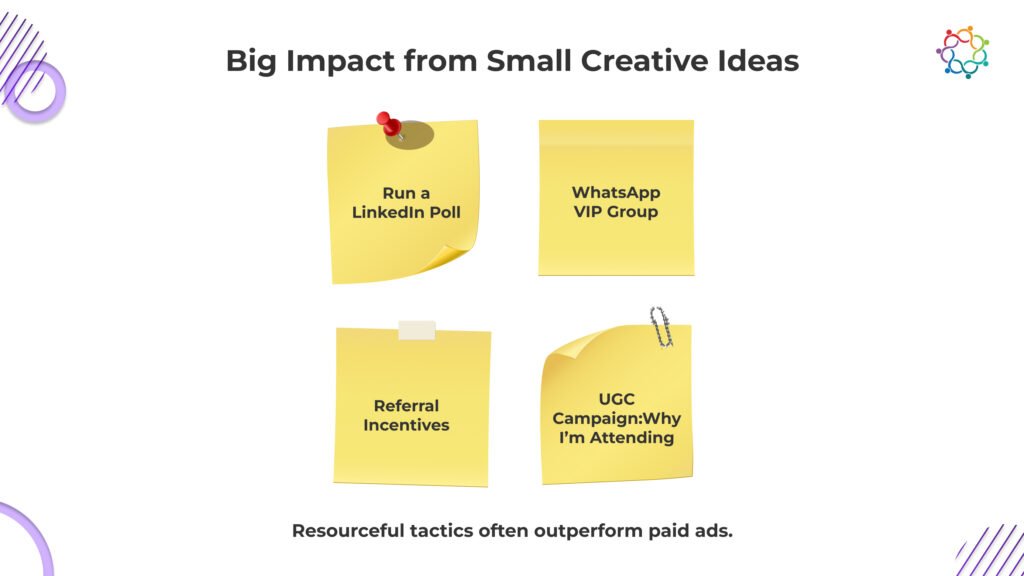
Sometimes the best promotion doesn’t mean needing a budget, only a good idea. These low-cost event promotion tactics will rely on creativity and knowing your audience.
- Interactive Polls or Contests on LinkedIn: If your theme allows for it, run a poll on LinkedIn. Think of a question and turn it live, which generally means a lot of people will be engaging and able to see you along with the process. As well, run a contest for a free ticket by simply asking people to post why they wanted to attend the event.
- WhatsApp Groups for curated attendees: Create a private WhatsApp Group for early registrants or VIPs to facilitate community and communication. It also creates exclusivity. Everybody else will be wondering how to get in with your group.
- User-generated content campaigns: Run a very simple campaign asking your audience to share their excitement. For example: Ask your audience to post a picture of themselves saying “why I’m excited to attend [Event Name].” You would then have your audience be your brands ambassadors.
- Incentivize referrals: There is no disadvantage to word-of-mouth. Provide registrants a small incentive (with a clear hook – discount, exclusive content etc. When a colleague registers for your event through their referral.
Budget Prioritization – Where Every Rupee Counts
When you have a small budget, you really must prioritize.
- Spend money on the content and relationships, not just ads: You need to change your mindset. Sometimes, that dollar spent on creating awesome content or building a relationship gets you a better long-term return on investment than a dollar on a click.
- Repurpose one asset in many ways: Be strategic. You can turn a single keynote speaker interview into a series of social media quotes, a blog post, a short video snippet and an email. Make the most of your resources by reusing not creating additional work.
- Focus on channels that have the highest organic reach: Find out where your audience is, and where you can get the most for your effort without spending money. This could be a specific LinkedIn group, a highly engaged sub-reddit, or a professional forum.

Want to see how this would work for you?
Run lean events without losing intelligence
See how budget-conscious teams use Samaaro to consolidate tools and stretch every dollar.
Book a tailored walkthroughSamaaro Spotlight – Do More with Less
Samaaro was built with the philosophy of maximizing value and doing more with less; using your limited budgets effectively. Samaaro has a robust platform with features built-in that eliminates manual work to help you get the best return on every rupee you spend.
- Budget Planner Keeps Spending on Track: With Samaaro’s Budget Planner, you can forecast costs, allocate budgets across different event activities, and track expenses in real-time. This ensures you never overspend while also helping you find areas to cut costs or reallocate funds for maximum impact.
- Automations Eliminate Manpower Costs: There are automated email sequences, with registration triggers and real-time reminders, that allow for consistent communication without manual input, allowing your staff to focus on high-value activities.
- Cross-Channel Dashboards Prevent Wasted Spend: A single dashboard shows everything you’ve done to promote your activity across different channels, allowing you to assess what is working and what isn’t, and stop any spend (on other media) quickly.
- Designed for Effortless Integration with CRM: Samaaro integrates perfectly with your existing CRM and marketing software, so you don’t have to pay for any expensive third-party integrations later.
- ROI Measurement Helps Demonstrate Value: Samaaro provides you with analytics and reporting so you can quickly and easily measure your ROI and prove even modest budgets can leverage significant and tangible value.
Constraints Drive Creativity
A tight budget is not a roadblock when planning an effective event promotion plan; it’s a chance. By developing a smart and economical event promotion plan, a budgetary limitation can turn into an opportunity for creativity and resourcefulness.
With a combination of owned channels, most impactful, organic approaches to promotion, and thoughtful, collaborative partner promotion – small teams can create big impact. Don’t forget it’s not about spending more, it’s about spending smarter.
Want more ideas to help contain costs? Download our Event Promotion white paper or learn more about how Samaaro helps ensure you maximize every rupee spent.
Frequently Asked Questions
1. What internal owned channels should event teams leverage first before spending on paid advertising?
Before spending on paid advertising, event teams should leverage their internal owned channels first: email to existing CRM contacts, employee LinkedIn networks, customer newsletters, website pop-ups and banners, sales outreach to target accounts, and existing community groups (Slack, WhatsApp, LinkedIn). These channels cost nothing and convert better because the audience already knows you. Spending on ads before exhausting owned channels is leaving free pipeline on the table.
2. How can organic promotion tactics like SEO content and speaker-led thought leadership build audience reach without significant spend?
SEO content and speaker-led thought leadership build audience reach without spend by attracting people who are already searching for the topic your event covers. Publish a blog post on the core theme 8 to 12 weeks before the event. Have speakers share their original insights on LinkedIn. Repurpose webinar recordings as content. Each piece compounds, drawing in new top-of-funnel audiences who can become registrants for this event or the next one.
3. How can sponsors, speakers, and industry associations be turned into promotion partners to multiply event reach at little to no cost?
Turn sponsors, speakers, and industry associations into promotion partners by making participation easy: give them pre-written posts, branded graphics, unique referral codes, and a clear ask. Sponsors want event success because it justifies their spend. Speakers want their session to be full. Associations want member value. When you give them ready-to-share assets, most will amplify enthusiastically, often reaching 5 to 10x your owned audience at no incremental cost.
4. Which cost-effective paid tactics deliver the best return for event teams promoting on a limited budget?
On a limited budget, the most cost-effective paid tactics are: retargeting ads to people who already visited your event page (highest conversion rate), LinkedIn ads with very precise targeting (job title + industry + company size), boosted posts on high-performing organic content, and WhatsApp Business API for personalised reminders. Skip broad awareness campaigns. Every paid dollar should chase an audience that’s already shown intent.
5. What guerrilla-style promotion ideas like LinkedIn polls, WhatsApp groups, and referral incentives can drive registrations without a large financial investment?
Guerrilla promotion tactics that drive registrations cheaply include: LinkedIn polls that surface engagement (then DM commenters with an invite), niche WhatsApp groups by industry or role, bring-a-peer referral codes (free pass for every 2 referrals), branded hashtag campaigns asking attendees to tag a peer, and creative content like quote graphics speakers want to reshare. These work because they ride on existing networks rather than buying access.
6. How should event teams prioritize a limited budget by focusing on content creation and repurposing assets across multiple formats?
Prioritise a limited budget by investing in one or two high-quality content assets (a flagship blog post, an explainer video, a designed agenda PDF) and then repurposing them across every channel. The same content becomes LinkedIn carousels, email content, WhatsApp messages, sponsor share kits, and post-event recap material. One asset can power 20 touchpoints. Creating 20 separate small assets wastes both time and money.
7. What percentage of a total event budget should typically be allocated to promotion?
Most organizations allocate 15 to 25 percent of the total event budget to promotion. New events without an existing audience often need the higher end to build awareness.
8. What free or low-cost tools can small teams use to design promotional graphics and content?
Canva handles graphics, CapCut edits video, Buffer schedules social posts, and Google Analytics with UTM builders tracks results. All offer free tiers that work well for small teams.
9. How can event teams measure which zero-cost promotion channel actually drove the most registrations?
Give every channel its own UTM link or promo code. Registration data will then show exactly which zero-cost channel, like email or LinkedIn posts, drove the most signups.
10. What’s a realistic timeline for seeing results from SEO-driven event promotion content?
SEO-driven event content usually takes two to three months to rank and drive registrations. Start early and target long-tail keywords your audience actually searches.
11. What common budget-wasting mistakes should small teams avoid when promoting an event on limited funds?
Avoid boosting posts without targeting, printing excess materials, running broad untargeted ads, and ignoring free internal channels like your email list, employees, and speaker networks.