

Why Marketers Confuse Analysis and Evaluation
In the field of event marketing, “post-event analysis” and “post-event evaluation” are often misconstrued as having the same meaning. This blend of two words often means reports that are very data heavy (lots of numeric results) but are also light on insights that can be turned into actions (i.e., there is a lot of detail but not much meaning). In the end, Leadership has a dashboard of data and little idea as what actions they should follow through post-event.
Analysis and evaluation represent two different but related steps in the overall event performance measurement process. One gives the facts and the other the tactical direction as a follow up. By understanding this important difference, you can transform your post-event reporting from a mere summary of what happened to an actionable approach for continuous improvement.
What Is Post-Event Analysis?
Post-event analysis is when you examine and compile the raw data on your performance. It is a factual and objective examination of what action was taken and the resulting outcomes from an event. This is the phase where you will obtain all relevant measurable outputs and put them together in a report.
- Focus: A focus on numbers and observable facts.
- Examples: Commonly referred measurable metrics include total registrations, attendance rates, click through rates (CTRs) on event-based emails, attributing revenue, or a raw NPS score.
- Strengths: The information is objective, measurable, and comparable. It will be a great source for benchmarking and historical record keeping for comparison into the future.
- Limitations: A post-event analysis cannot tell you why something has happened. It will tell you that people dropped off a session to the tune of 40%, but it can’t tell you why they dropped off.
What Is Post-Event Evaluation?
Post-event evaluation is the step in the process where you take the data from your analysis and evaluate it against your prior expectations, goals, or targets (whatever you called them). It is the evaluative part of the process where you will draw conclusions and provide an actionable level of recommendations based on the data and information you collected; it takes raw data and then provides meaning and direction.
- Focus: The focus is on evaluating outcomes and providing strategic conclusions
- Examples: Evaluation will help provide an answer to questions such as; “Did we achieve our lead-generation targets?” Did the content resonate with our target core audience? or did we achieve our brand growth targets?
- Strength: The reasoning behind evaluation is strategic, actionable, and will relate event performance back to business objectives to help you understand the value of your event
- Limitations: The limitations of this process rely more on interpretation, context, and knowing exactly where you started. You must understand what your goals were going to be going into the event, meaning that without a solid understanding and evaluation process, you can’t evaluate the event.
The Key Differences – Analysis vs Evaluation
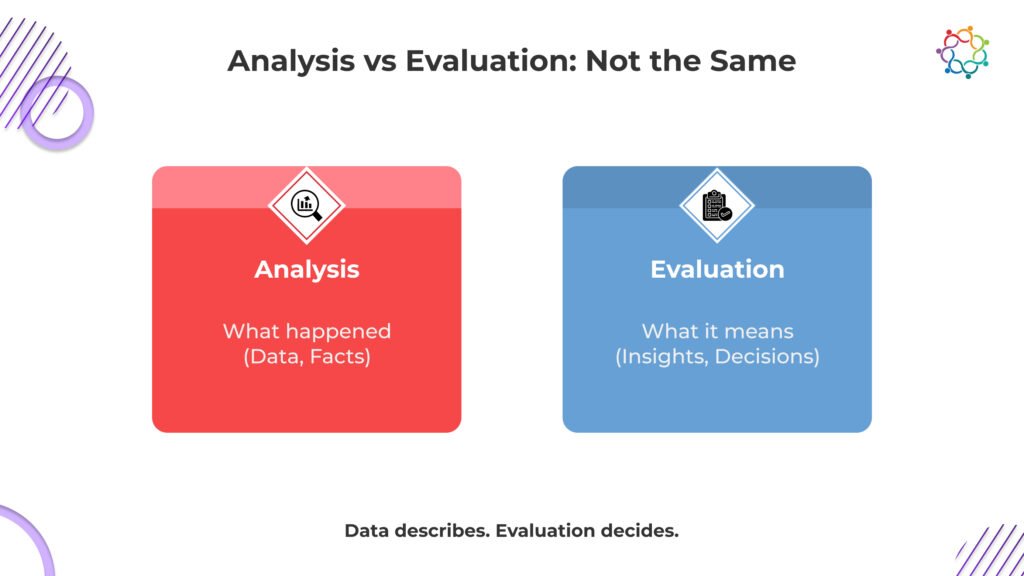
The difference between these two processes can be summarized in a powerful but simple way:
- Analysis = What happened. (It is descriptive.)
- Evaluation = What it means, and what to do next (It is interpretive and prescriptive.).
Think about it this way: an event reporting framework begins with analysis and ends with evaluation.
For example;
- Analysis → “40% of attendees dropped off after session 2.”
- Evaluation → “The reason for the drop off was probably that the content was an advanced topic and the audience was expecting a beginner level session; for the next event we should reformat that content into a ‘deep dive’ track and segment the audience.”
Analysis gives you the diagnosis; evaluation gives you the treatment plan. You can’t have a decent treatment plan without a proper diagnosis, and a diagnosis without a treatment plan is useless.

Want to see how this would work for you?
Get both, automatically
See how Samaaro generates analysis dashboards and evaluation reports from the same data.
Book a tailored walkthroughWhy You Need Both for a Complete Picture
The performance measurement for events is not fully complete without both evaluation and analysis.
- If you rely on analysis alone, you are left with a pile of numbers that are, for all intents and purposes, meaningless. You would have a dashboard with lots of indicators and action items, with no real way of knowing what decisions to make based on it.
- If you rely on evaluation without the analysis, then you are ultimately just giving you opinion, with no accountability. You may feel like the event was successful, but you have no data to back up your anecdotal claims or to support future funding for your event.
Combining evaluation and analysis creates a true feedback loop. The analysis provides the evidence and the evaluation uses this evidence to support decisions in the event strategy and provides an organizational justification for celebrating event success.
Common Mistakes Teams Make
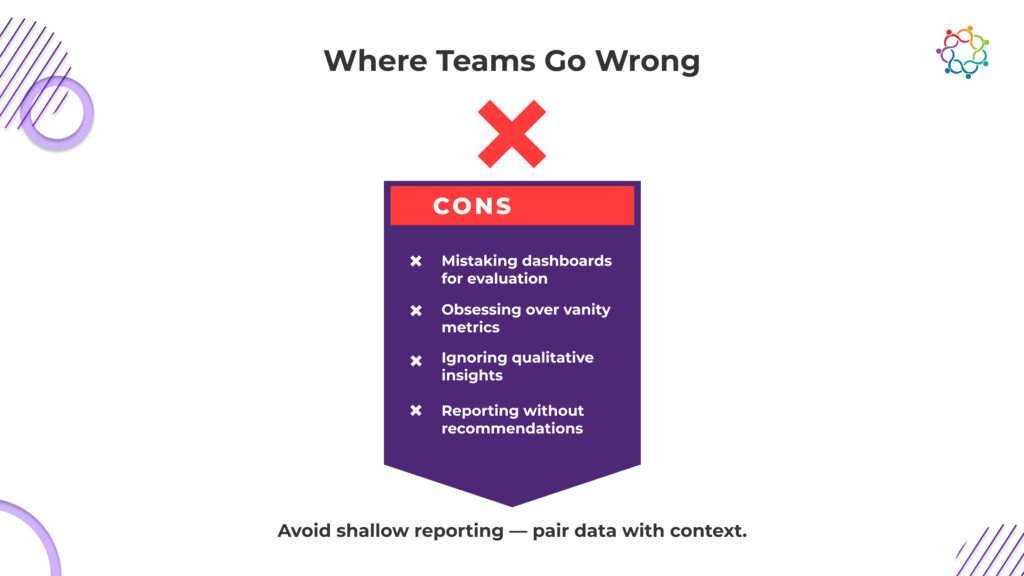
Even when teams are clear on the difference, they still fail to synthesize complete evaluation components. The most common observations include:
- Mistaking dashboards for evaluation: A data dashboard is an analytical tool, not an evaluative one. Just because you look at some numbers, does not mean that you have done due diligence in terms of an evaluation process.
- Over-weighting vanity metrics: it is easy to measure awkward numerical aspects, like social media impressions or total registrations (analysis). However, it’s important as part of evaluation to connect it to your business goals (evaluation).
- Missing qualitative elements: In a quantitative analysis, there is seldom a human element. Evaluation requires the human element as well; you need to understand the why behind the numbers, and that requires qualitative feedback.
- Reporting data without recommendation: One of the largest failings comes from reporting data with a beautiful graph of the data, but no prescriptive recommendation coming from it. The best reports do not just report, but they also recommend action.
Framework – From Analysis to Evaluation
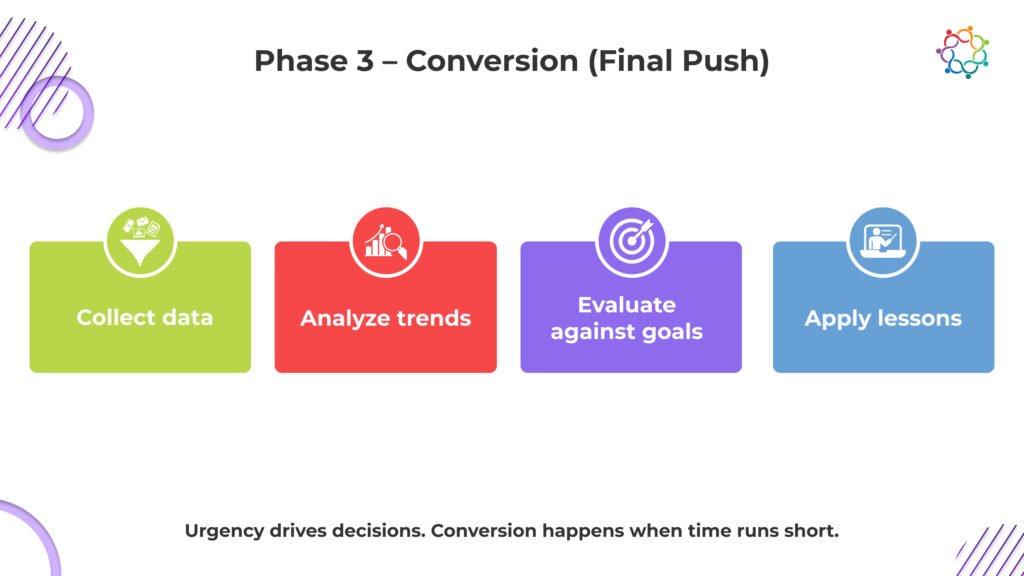
Here is a simple four-step model to assist your team in growing their capacity to better understand best practice for event analysis and post-event evaluations:
- Collect: Collect quantitative data (registrations, attendance, clicks etc) and qualitative data (open-ended survey responses, reflections from staff, testimonials, etc.)
- Analyse: Analyse the data you have collected as systematically as possible. Look for trends, patterns, and outliers in the raw data. Were there some numbers greater than the number you thought they would be, conversely, were there some numbers smaller than they ended up being? What was the most popular session during your event?
- Evaluate: Evaluate your data against your event goals. Did you achieve your goals? What can you conclude from the data? What were the positives, and negatives?
- Apply: Apply your learning and create some recommendations for your next event. This is the final, and most important step, and it is where you use your evaluation as leverage on the journey towards successful future events.
Samaaro Spotlight – Bridging Analysis and Evaluation
Samaaro is designed to effectively connect analysis to evaluation, allowing you to measure your event results in the best way possible.
- Analytics Dashboards create the utility and dimension behind a thorough post-event analysis offering your key metrics in real-time.
- The Feedback Manager provides an easy way to capture qualitative insights with customizable surveys and polls giving you a strong evaluation plan packed full of attendee experiences.
- Auto-generated reports support your data in becoming evaluation-ready insights, showcasing the full scope of event data results in a single location.
- CRM integrations allow for pipeline attribution directly connecting your event data to ROI by providing you with strategic insights to justify your event’s value.
Don’t Just Analyse, Evaluate
At the end of the day, the numbers provide a narrative, but evaluation tells that narrative’s moral. The best event teams do not end with “this happened,” but rather ask, “what does this mean, and what should we do now?” Analysis and evaluation help provide unique leverage not only to demonstrate the value of your event but also to improve every event you host.
Want to master analysis and evaluation? Download our Post-Event Evaluation white paper or have a look at how Samaaro works both methods together to show a clear path from analysis to evaluation.
Frequently Asked Questions
1. What is the difference between post-event analysis and post-event evaluation?
Post-event analysis is the data-collection step: pulling raw numbers like registrations, attendance rate, CTR, and NPS into one report. Post-event evaluation is the interpretive step: comparing those numbers against your original goals and deciding what they mean and what to change. Analysis tells you what happened. Evaluation tells you why and what to do next. You need both, but most teams stop at analysis.
2. Why is post-event evaluation important after an event?
Post-event evaluation is important because it turns event data into strategy. Without evaluation, leadership sees a dashboard of numbers but doesn’t know whether to invest in another event, change the format, or shift budget elsewhere. Evaluation answers the questions that matter: did the right audience attend, did the event move pipeline, and what should we do differently next time.
3. What metrics should be included in post-event analysis?
A complete post-event analysis should include: total registrations, attendance rate, no-show rate, session attendance, engagement scores (polls, Q&A, networking), NPS and satisfaction ratings, leads captured, leads qualified, pipeline influenced, revenue attributed, social media reach, and cost per registration. Group them into three buckets: reach, engagement, and business impact. The third bucket is the one executives care about most.
4. When should post-event evaluation be done?
Post-event evaluation should run in three phases: immediately after the event (operational debrief with the team, within 48 hours), short-term (within 2 weeks, once survey responses and engagement data are in), and long-term (90 days post-event, once pipeline and revenue attribution is clear). One evaluation right after the event misses the strategic outcomes that take weeks to surface.
5. How do post-event analysis and ROI connect?
Post-event analysis connects to ROI when attendance and engagement data are linked to CRM pipeline. The chain is: registrations to attendance, attendance to engagement, engagement to lead quality, lead quality to opportunities, opportunities to closed revenue. If your analysis stops at ‘how many people came’, ROI stays a guess. If it tracks every attendee through to pipeline, ROI becomes a number you can defend in a board meeting.
6. What are the key outcomes of a strong post-event review?
The key outcomes of a strong post-event review are: a clear verdict on whether the event hit its goals, a documented list of what worked and what didn’t, specific actions for the next event, ROI defended with attribution data, and institutional knowledge captured so future teams don’t start from scratch. A weak review produces a PDF nobody reads. A strong one becomes the playbook for the next event.
7. What is the difference between post-event analysis and post-event evaluation?
Post-event analysis is the fact-finding step. You gather the raw numbers like registrations, attendance, email clicks, and survey scores. Post-event evaluation is the meaning-making step. You compare those numbers against your goals and decide what they tell you and what to do next. In short, analysis tells you what happened, and evaluation tells you why it matters.
8. Why is post-event analysis important for measuring event success?
Post-event analysis gives you the hard facts about what actually happened at your event. Without it, you are guessing. It captures measurable results like how many people registered, how many showed up, and how they engaged. These objective numbers become your benchmark, so you can compare events over time and prove results instead of relying on opinion.
9. What is the four-step framework for turning event data into better future events?
The blog lays out a simple four-step loop. First, collect both your numbers and your written feedback. Second, analyze that data to spot trends, surprises, and your most popular sessions. Third, evaluate the results against the goals you set. Fourth, apply what you learned by writing clear recommendations for your next event. Collect, analyze, evaluate, apply.
10. How do you measure holistic event performance after an event?
You measure holistic performance by using both analysis and evaluation together, not just one. Analysis gives you the raw numbers, and evaluation gives those numbers meaning by comparing them to your goals. You also mix hard data with human feedback, so you understand both what happened and why. Looking at the full picture stops a single number from misleading you.
11. What raw data should be collected during post-event analysis?
Collect the measurable outputs from your event. That includes total registrations, attendance rate, how many people dropped off during sessions, email click-through rates, survey or NPS scores, and any revenue or pipeline tied to the event. Gather both the quantitative numbers and the qualitative comments from surveys and staff, so you have everything ready to evaluate later.
12. How do you evaluate event data against prior expectations and goals?
Start by knowing the goals you set before the event, like a lead target or attendance number. After the event, line up your actual results next to those goals and ask simple questions. Did we hit the target? Did the content reach the right people? The gap between what you hoped for and what happened is your evaluation.
13. What actionable recommendations come from post-event evaluation?
Good evaluation does not just report numbers, it suggests what to do next. For example, if many people left after one session, the recommendation might be to reformat that content or split the audience. Recommendations turn findings into a plan, such as changing the agenda, picking different speakers, or adjusting your promotion for the next event.
14. Why can’t a single metric tell the full story of event success?
One number, like total attendance, only shows a small slice of a layered experience. It might tell you people showed up, but not whether the right people came, whether they engaged, or whether the event moved any deals forward. Relying on a single metric leaves you with more questions than answers and can make a weak event look strong.
15. How do you use post-event analysis and evaluation for data-driven insights?
Treat them as a loop. Analysis provides the evidence, and evaluation uses that evidence to make decisions. Together they create a feedback cycle where every event teaches you something for the next one. Instead of just saying this happened, you can say this happened, here is what it means, and here is what we will change.
16. What is the relationship between analysis facts and tactical direction in event performance measurement?
Analysis gives you the facts, and evaluation gives you the direction. Think of it like a doctor. Analysis is the diagnosis that tells you what is wrong, and evaluation is the treatment plan that tells you what to do about it. You need both. Facts without direction are just numbers, and direction without facts is just opinion.