

Feedback Isn’t Just a Form, It’s a Strategy
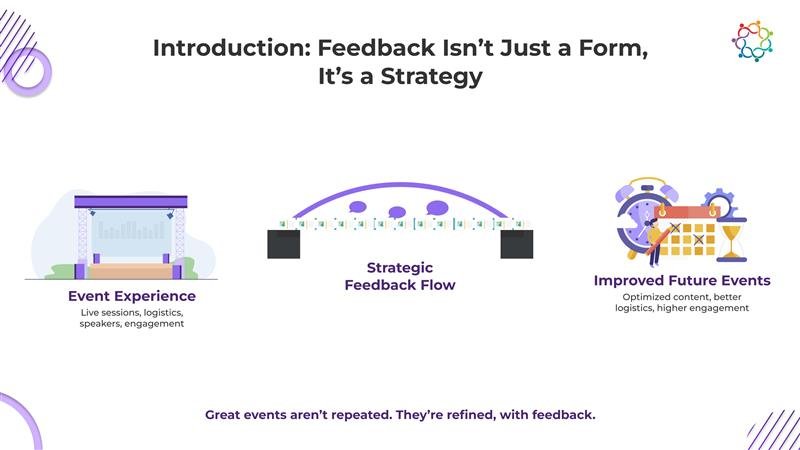
Post-event feedback remains one of the most powerful, yet underutilized, tools in an event marketer’s arsenal. While there’s plenty of data to analyze during and after an event, only a small percentage of event teams actually use that data to drive meaningful improvements.
A recent study found that only 40% of event organizers go beyond asking a Net Promoter Score (NPS) or a basic satisfaction question. As a result, they miss out on deeper insights into what participants were truly thinking and feeling. This surface-level approach overlooks the nuance of attendee engagement and sentiment entirely.
But when feedback is gathered intentionally, distributed strategically, and analyzed for patterns, it becomes a gold mine. A well-executed feedback campaign doesn’t just tell you how attendees felt, it reveals why they felt that way, which sessions had the most impact, and which aspects need improvement before your next event.
In this blog, we’ll explore how to go beyond basic survey tools and unlock the full potential of feedback to elevate your event outcomes.
Why NPS Is Just the Beginning
The Net Promoter Score (NPS) has been a popular way to measure how attendees feel after an event. It gives you a quick idea of overall satisfaction, but it doesn’t tell the full story.
Here are some of its limitations:
- It tells you “What,” not “why.” For example, a score of 7 or 8 might be because of poor speakers, bad session timing, or even average food – but NPS doesn’t explain which.
- It lacks detail. If your event has different sessions or tracks, you need to know how each one performed – not just the event.
- It treats everyone the same. But not all attendees have the same expectations. Their job role, experience level, or reason for attending can change how they see the event.
To get a full picture, NPS should be combined with more detailed feedback – like session ratings, open comments, speaker reviews, and questions about whether they’ll attend again.
For example, an event might have an overall NPS of 46. But a deeper look could show that 64% of breakout session participants mentioned poor moderation or said the content wasn’t relevant to them. These are the kinds of insights that NPS alone can’t reveal.
It also helps to break down responses by audience type. For example, a CMO and a product manager might react differently to the same session. A strategic keynote might be exciting for the CMO but less useful for the product manager, who prefers hands-on demos. First-time attendees may also rate things differently than repeat participants. When you group feedback this way, you get more useful insights.
The Campaign Flow – In-App, Email, and WhatsApp
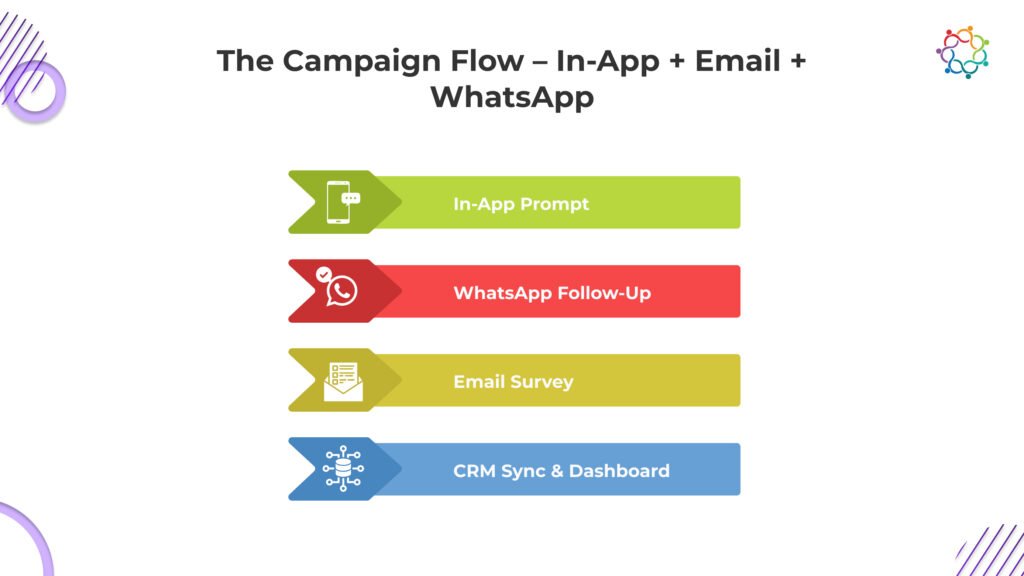
Different attendees respond differently to feedback requests, varying by how and when you ask. That’s why a multi-channel feedback campaign is essential for getting the insights you need.
Here is how an ideal feedback campaign flow can look:
- In-App Prompt: Push a simple session rating through your event app right after a session ends. This captures feedback while it’s still fresh, leading to faster responses and more engagement.
- WhatsApp Follow Up: For attendees who opted into WhatsApp, send a quick emoji selection or a multiple-choice question about their experience. These small interactions lower the barrier, making it easy for them to share thoughts and giving you immediate, actionable data.
- Email Survey: Within 24 to 48 hours after the event, send a comprehensive email survey. Use logic branching to organize questions by session type, attendee role, or ticket purchased. This allows you to personalize the survey without overwhelming attendees, ensuring you get better, more relevant insights.
Best practices for this flow:
- Keep in-app and WhatsApp surveys under 1 minute.
- Email surveys should take no more than 3 minutes to complete.
- Use clear calls to action like “Rate this session” or “Share your thoughts.”
- Automate one follow-up reminder on both email and WhatsApp, spaced 48 hours apart.
Timing is key. Most feedback comes in during the first 24 hours and drops sharply afterward. After 72 hours, response rates can fall by as much as 60%. Use automation to time your requests perfectly and maximize engagement, ensuring you collect data you can truly act on.
Tools to Power Feedback Collection
Running a multi-channel campaign requires the right set of tools. Below are the most used tools across different event sizes and needs:
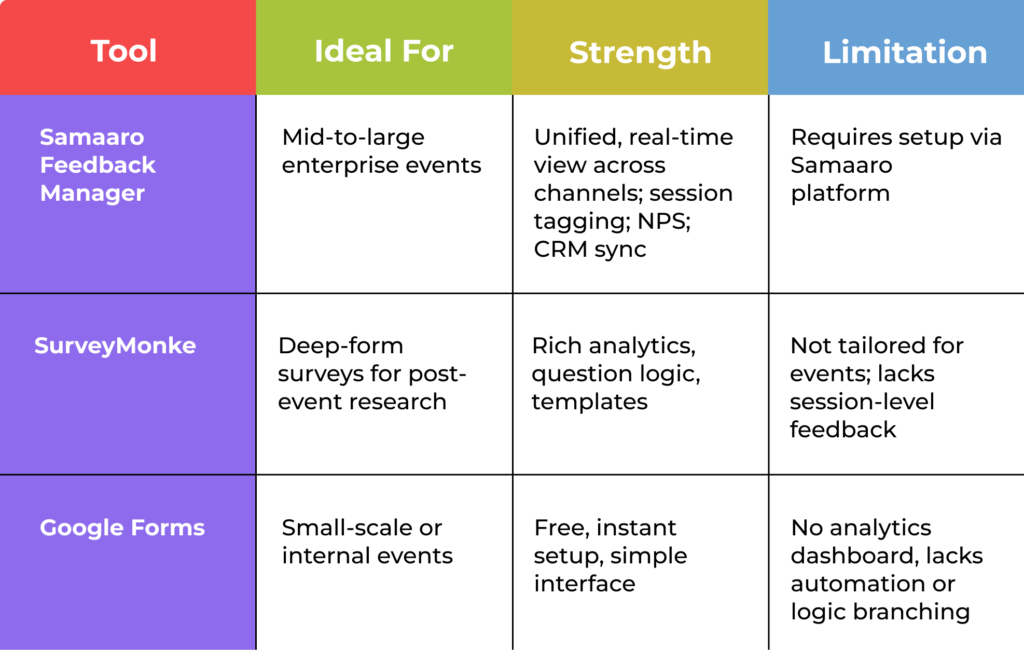
When picking tools, ensure they connect directly to your CRM or event platform. The real power of feedback data comes from linking it back to the attendee’s profile. For example, if an attendee rates a product demo poorly, your sales team needs that information before their next interaction.
Look for tools that:
- Distribute surveys directly, whether in-app or via email.
- Provide real-time dashboards.
- Allow tagging on sessions, speakers, or formats.
- Integrate directly with your CRM, marketing automation platform, or attendee analytics system.
For teams using Samaaro, the Feedback Manager consolidates session feedback and event level scoring. It immediately exports data, offering optional NPS scores and tagging for all feedback.
Designing Smart Feedback Forms
Effective feedback is not just about questions; it is about structure. Modular, role aware, and intent based forms offer the best response rates and the most usable insights.
Block 1: Event-Level Questions Gauge overall sentiment:
- “How would you rate your overall experience?” (1–5 scale)
- “How likely are you to recommend this event?” (NPS)
- “What did you enjoy most?” (Open-ended)
- “What could we improve?” (Optional)
Block 2: Session-Level Feedback Evaluate specific attended sessions:
- “Please rate [Session Name]” (1–5 stars)
- “Speaker Effectiveness” (Likert scale)
- “Was the content relevant to your role?” (Yes/No)
- “Specific feedback for this session?” (Text box)
Block 3: Logistical Feedback Improve event delivery:
- “How would you rate the registration process?”
- “Was the venue/app easy to navigate?”
- “Any challenges with check-in or session access?”
Block 4: Follow-Up and Consent Capture intent and future engagement preferences:
- “Would you attend next year?”
- “Would you like follow-up materials?”
- “Permission to use your feedback anonymously?”
A well-structured form improves submission rates and enables precise data slicing. For example, if all negative feedback comes from first-time attendees, your onboarding or welcome flow might need improvement.
From Data to Action – Closing the Loop
Feedback without follow-through creates distrust. Once you collect data, your team must act swiftly and transparently to build attendee loyalty.
- Categorize Your Feedback: Group data by themes like content, logistics, or speaker performance. Tools like Samaaro’s software include tagging and heat mapping features to help you score top praise and pinpoint pain points quickly. This structure makes feedback actionable.
- Use Dashboards for Trends: Dashboards help you visualize trends and patterns. Were sessions held before lunch consistently receiving lower scores? Did one speaker stand out with significantly higher ratings than others? Dashboards provide the clarity you need to spot these insights.
- Close the Loop: Share a “What We Learned” or “You Said, We Did” report with your attendees. This not only builds trust and transparency but also encourages them to engage more deeply with future surveys you send.
- Implement Learnings Immediately: If you run a regularly recurring event format, start applying feedback results to your event strategy right away. Adjust speaker cohorts, refine time slots, or modify breakout modalities based on audience input. Even small changes, like scheduling later sessions based on feedback, can increase satisfaction by as much as 20%.
- Leverage Learnings for Future Campaigns: Use these insights to refine your next marketing efforts. Prioritize attendees with very high engagement and Net Promoter Scores for exclusive invites or upsell campaigns. Contacts with neutral or negative survey scores could go into recovery sequences or re-engagement efforts focused on replay series.
The cycle is simple yet powerfully impactful: Collect, Analyse, Act, Repeat. Closing the loop is what truly transforms raw feedback into a significant competitive advantage for your events.
Feedback That Fuels Growth
The most successful event marketing teams use feedback not as a checkbox, but as a compass. When executed well, post-event feedback initiatives empower you to improve the next experience, prove ROI, and boost attendee engagement.
Whether you choose to use in-app surveys, email forms, or WhatsApp messages, feedback should be timely, structured, and ready to act on immediately. NPS is just one part of the puzzle; the true value comes from how you manage form design, segmentation, and analysis.
If you are ready to move beyond basic surveys and create campaigns that generate true insights, Samaaro’s Feedback Manager is designed to streamline the entire feedback lifecycle. It centralizes responses, automates distribution, and simplifies reporting, giving you back time to focus on improvement rather than just collection.
Looking to build feedback flows that do something? Talk to our team to see how Samaaro’s Feedback Manager can make it happen.
Frequently Asked Questions
1. What are the limitations of relying only on Net Promoter Score (NPS) for event feedback?
NPS gives you one loyalty score but no reasons behind it. It misses session-level insight, logistical issues, and the specific fixes that actually improve your next event.
2. What is the ideal timeline for sending post-event feedback surveys?
Send the first survey within 24 hours while the experience is fresh, then follow up with non-responders after two to three days through a different channel.
3. What should an event feedback form include beyond overall satisfaction ratings?
Beyond satisfaction ratings, include session-level feedback, logistical questions, open-ended comments, future topic interests, and consent for follow-up communication.
4. What is a “You Said, We Did” report and why does it matter for future events?
A You Said, We Did report shows attendees exactly how their feedback changed the next event. It builds trust and noticeably lifts future survey response rates.
5. How can feedback data be integrated with a CRM to support sales follow-up?
Syncing feedback into your CRM lets sales tailor follow-up by sentiment, flags hot leads who expressed interest, and connects attendee opinions to revenue conversations.